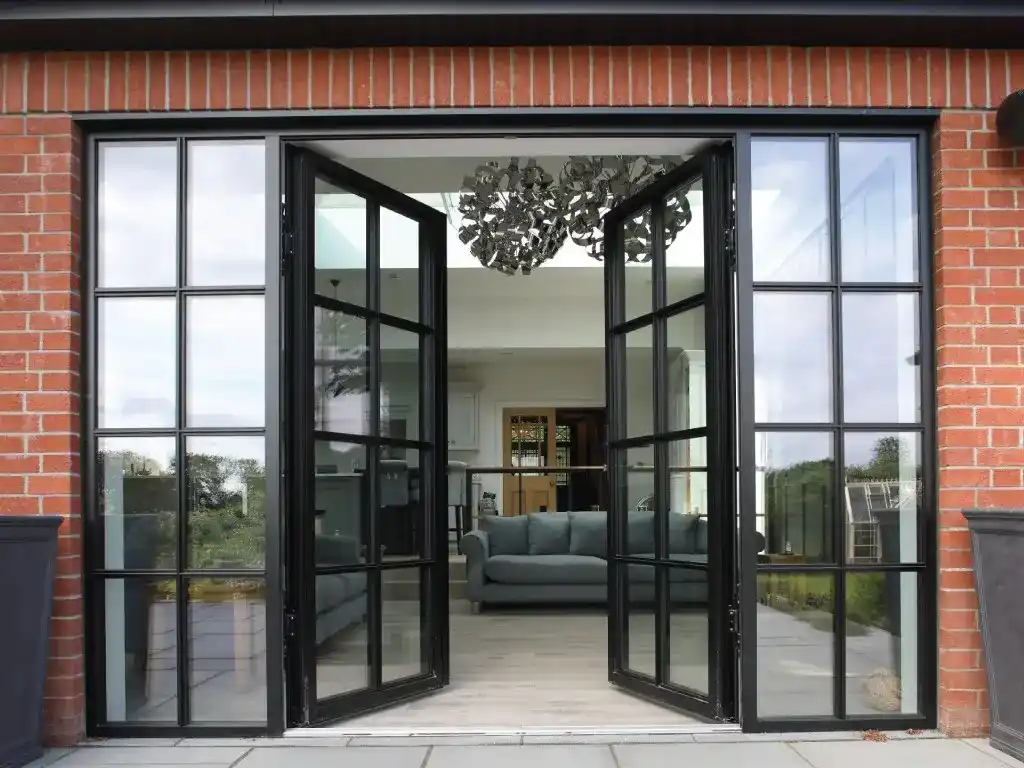
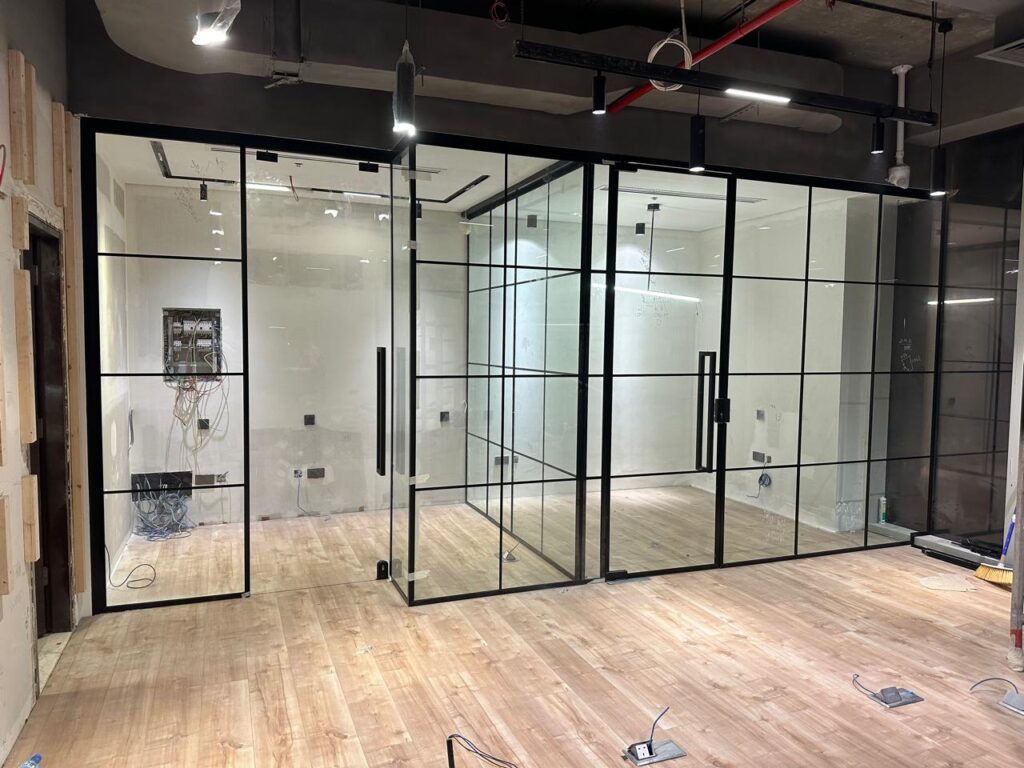
Sliding doors have six genuine weaknesses. Four of them are specification problems you can design out before you order. Two of them are physics, and no supplier can remove them. This page separates the two honestly, because knowing which is which is the difference between a door you are happy with and one you regret.
Written by the team that builds and repairs them · free site visit across Dubai
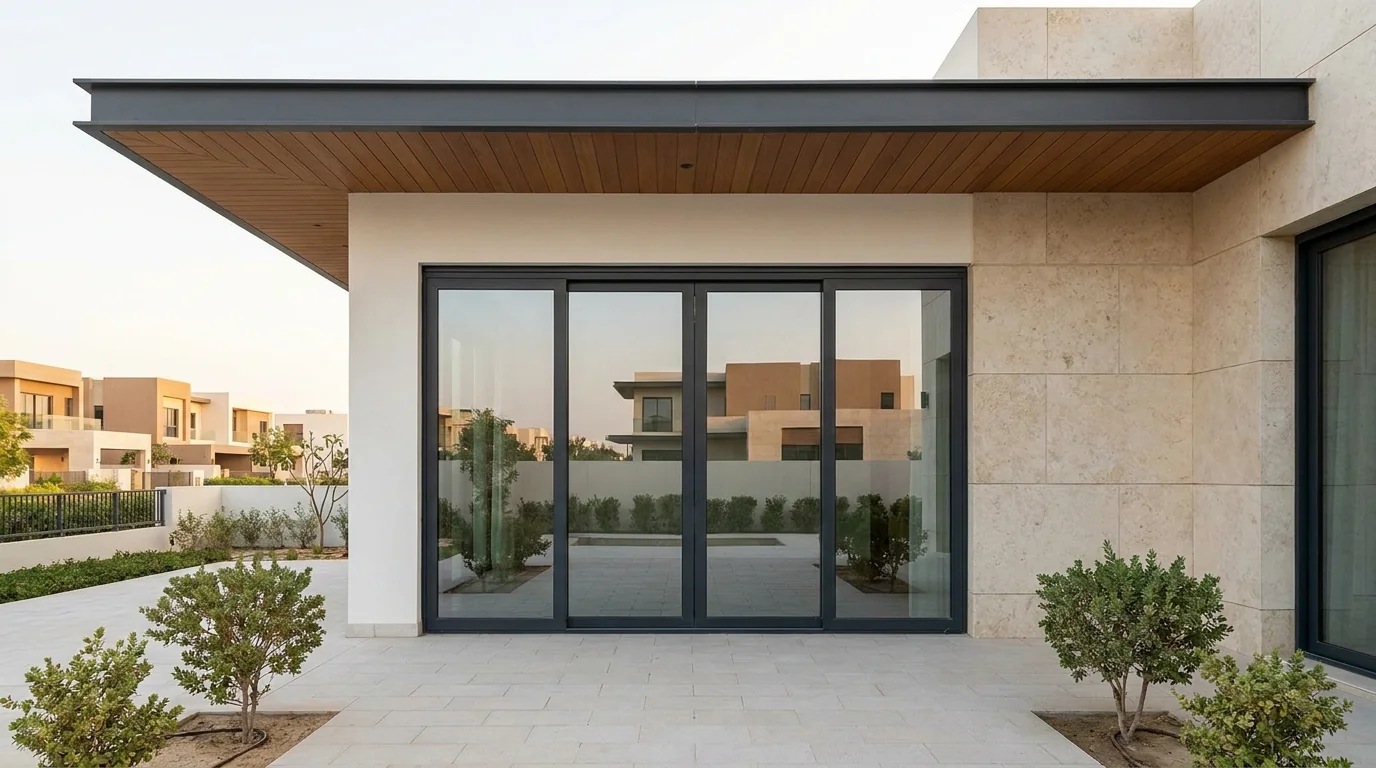
The short answer
A sliding glass door has six real disadvantages. Ranked by how often they actually cause a complaint:
- Only part of the opening clears. A panel has to slide behind something, so a two-panel door opens to about half its width. This is physics, not a specification failure.
- The bottom track collects grit. Fine sand is rolled flat by the carriages and wears the rollers. Manageable, but it is a job that never goes away.
- It cannot seal like a hinged door. A leaf that moves sideways cannot be compressed into its frame the way a hinged leaf is. Good gear closes most of the gap; nothing closes all of it.
- Security depends entirely on the specification. A cheap slider is genuinely easy to defeat. A properly specified one is not. The frame has almost nothing to do with it.
- A big glass area gains heat. In Dubai this is the single most expensive mistake to get wrong, and it is a glass decision rather than a door decision.
- Panel weight caps the size. Past a certain weight you move to heavier gear, and heavier gear needs more aluminium, which works against the slim look people want.
Which are fixable: sealing, security, heat gain and panel weight are all specification decisions. The clear opening and the track cleaning are not. They come with the system, and if either of those is a dealbreaker you want a different type of door.
1. Only part of the opening ever clears
This is the disadvantage people notice first and the one no supplier can engineer away. A sliding panel travels sideways, so it has to end up somewhere: behind another panel, or inside a wall.
What you actually get
- Two panels, two tracks. About half the opening clears.
- Four panels, two tracks. Still about half, but it opens from the middle.
- Three track. Roughly two thirds clears, at the cost of another interlock in the closed view.
- Telescopic multi-slide. Two thirds to three quarters clears. See telescopic sliding doors.
- Pocket sliding. Effectively all of it, because the panels disappear into the wall. It has to be designed into the wall before it is built.
How to design around it
If the clear width genuinely matters, say a serving counter, a route people carry things through, or a terrace used for entertaining, the answer is a pocket cavity at design stage, a telescopic run, or a folding door. If it does not matter, and for most living rooms it does not, this stops being a disadvantage at all.
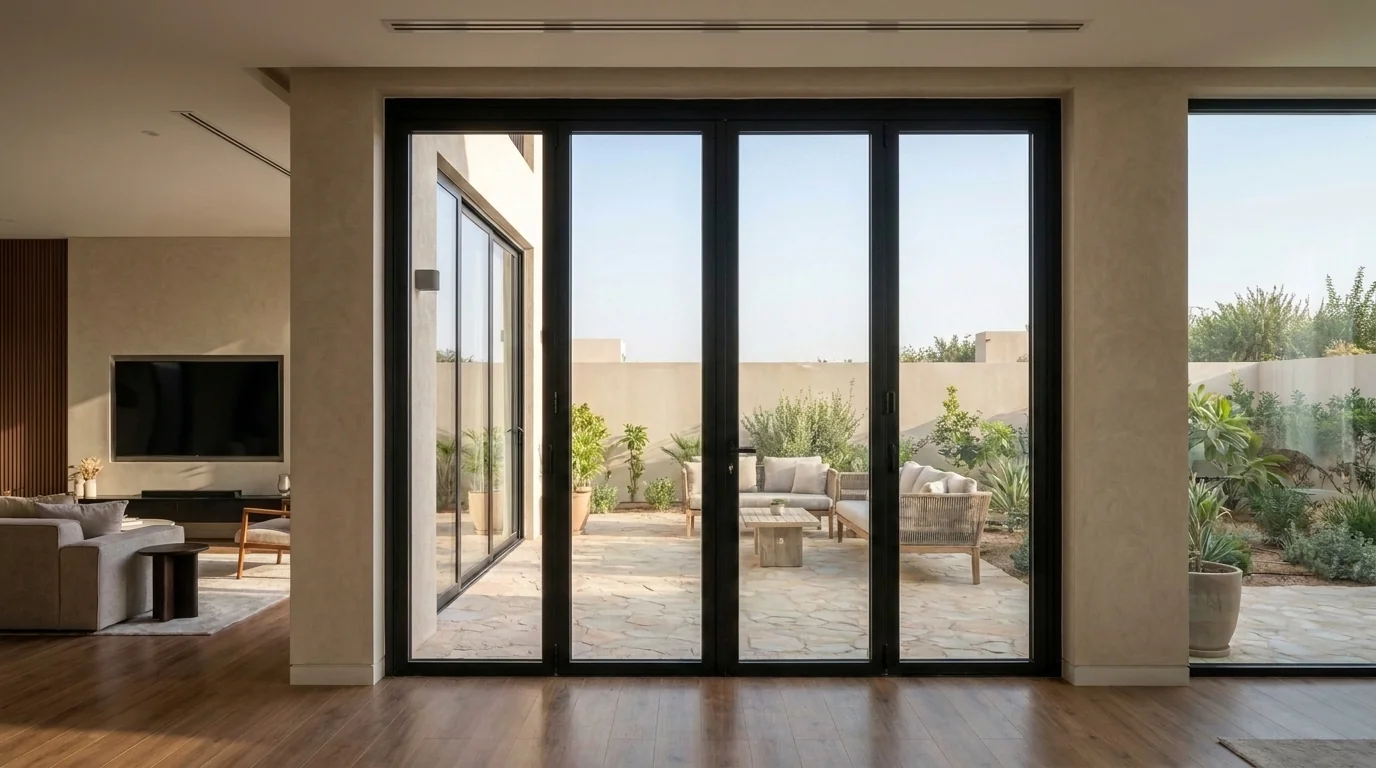
2. The bottom track is a maintenance job that never ends
In this climate, fine sand finds its way into every external track. The carriages roll over it, flatten it, and it becomes an abrasive paste that wears the rollers and the track surface together.
What actually happens
Grit does not stop the door immediately. It adds friction, the door gets heavier to pull over months, and by the time it is obviously stiff the rollers have already worn.
Why oil makes it worse
Grease and oil in the channel collect more sand and hold it against the rollers. Keep the channel dry and vacuumed, and use a silicone-based lubricant sparingly on the rollers only.
How much work it is
A crevice tool along the channel, both ends, once a month. Weep holes checked quarterly. That is the whole programme for an external door.
What reduces it
A top-hung system puts the load in the head instead of the floor, so grit in the bottom channel matters far less. It costs more and needs a head that can carry the panels.
This is a real and permanent disadvantage of any bottom-rolling slider, and it is worth knowing before you buy rather than discovering in year two. If a door is already stiff or dropping, it is usually a service rather than a replacement. See sliding door repair in Dubai.
3. A slider cannot seal the way a hinged door does
A hinged leaf is pulled into a compressed gasket all the way round. A sliding leaf has to be free to move sideways, so it meets its seals by sliding along them rather than pressing into them. That difference is built into the system.
What it means in practice
- Air leakage is higher than an equivalent hinged or casement opening, all else being equal.
- Sound follows air. A door that leaks air leaks traffic noise, which is why acoustic performance and air-permeability class track each other so closely.
- Dust follows air too, which is the complaint we hear most after a shamal.
- Driven rain needs somewhere to go, so the sill has to be a drained type rather than a flat threshold with a gasket on it.
What genuinely narrows the gap
- Lift-and-slide gear. The handle lifts the panel off its seals to move it and drops it back down onto them to close. This is the single biggest improvement available, and it is why large slim sliders usually use it.
- Compression gaskets, not brushes alone. Brushes stop dust; gaskets stop air. A system with only brush seals will never test well.
- Multipoint locking. Engaging at several points up the interlock pulls the panel into its seals along the whole height rather than at one point.
- A drained sill formed in the slab. A channel and weep path that takes water out rather than letting it stand against the frame.
Ask for numbers, not reassurance. Air permeability is classified under EN 12207, watertightness under EN 12208 and wind resistance under EN 12210. A supplier who can quote the class and produce the report is telling you something; one who says “fully sealed” is not.
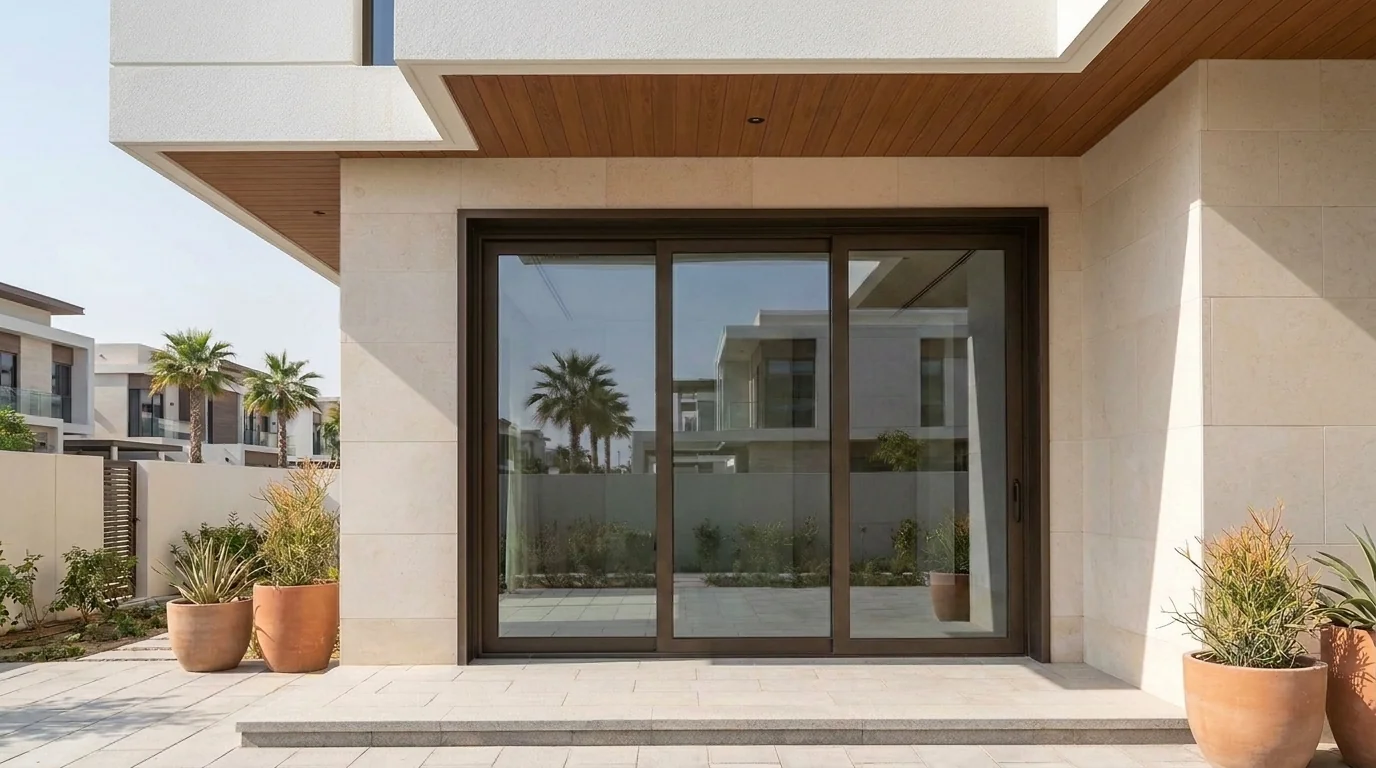
4. Security is entirely a specification question
The reputation is fair, but it belongs to cheap sliders rather than to sliding doors as a category. Three weaknesses account for almost every forced sliding door, and all three have a standard fix.
The three weaknesses
- A single central catch. One locking point means the panel can be levered at the opposite end.
- Lifting the panel off its track. On a cheap slider a closed panel can be lifted out of the bottom channel entirely.
- Breaking a single toughened pane. Toughened glass shatters into small pieces and leaves a clean opening.
The three fixes
- Multipoint locking with hooks or bolts engaging at several points up the interlock.
- Anti-lift blocks that physically prevent the panel being raised when closed.
- Laminated glass. The interlayer holds the pane together when broken, so there is no clean opening. This does more for security than any amount of aluminium.
Frame thickness is almost irrelevant here, which is why a well specified slim door can be more secure than a chunky one with a single catch and toughened glass.
5. Heat gain: the expensive one in Dubai
A sliding door is mostly glass by area, so its performance is largely the performance of its glass. Get this wrong on a west-facing unshaded opening and you will feel it every afternoon from May to September.
Are sliding glass doors energy efficient?
They can be, and the honest answer is that it depends almost entirely on the glass and the frame construction rather than on the fact that it slides. A double-glazed, solar-controlled unit in a thermally broken frame performs well. A single-glazed unit in a plain aluminium frame performs badly, and no amount of good gear compensates.
- What drives the result
- Double glazingthe sealed cavity does the work
- Solar-control coatingrejects energy before the cavity
- Thermal break in the framestops the aluminium bridging heat
- Warm-edge spacerreduces the cold bridge at the unit edge
- What to ask for in writing
- Uwfor your actual panel sizes
- g-valuesolar heat gain coefficient
- Coating surfacewhich face it sits on
- Framethermally broken, stated explicitly
We will not quote you a percentage off your cooling bill, because that depends on your building, your shading, your set point and your habits. What we will do is put the calculated figures for your panels on the quotation so you can compare like with like. If shading rather than glazing is the constraint, a pergola over the opening changes the numbers more than any glass upgrade will.
Orientation matters more than people expect. The same door on a north elevation and a west elevation are two different problems. Specify the acoustic and solar glass on the elevations that need it rather than across the whole villa.
6. Panel weight caps how big you can go
This is the disadvantage that quietly decides the design, and it is the one most often discovered after a deposit has been paid.
- The opening and panel count set the panel area. Fewer, larger panels look better and weigh more.
- The glass build-up sets the weight. Thickness, laminate interlayers and the number of leaves multiply up quickly.
- The weight sets the gear. Rollers and carriages are rated in kilograms. Past certain weights you move to heavy-duty gear, and past that to a motorised leaf.
- The gear sets the minimum interlock. Heavier gear needs more aluminium around it, so the frame you see gets wider.
- The structure carries all of it. The head must not deflect onto the panels and the floor must take the point loads at the track.
The useful question to put to any supplier: at my panel size, with the glass you are proposing, what is the weight per panel and what is the rated capacity of the gear you are quoting? Both numbers go on our quotations as standard. Where the answer pushes a single slider past its limit, a stacking arrangement is usually the better route. That is covered on ultra-slim sliding doors.
The disadvantage nobody mentions: parts
A sliding door is a mechanism. Mechanisms wear, and in ten years you will need a roller, a gasket or a lock case. Whether that is a service visit or a new door is decided at the moment you buy.
Unbranded gear
If nobody can identify the carriage, nobody can order a replacement. A broken handle then becomes a whole new door.
Named hardware
Gear and locking from established manufacturers. We fit Roto, Siegenia or GU, so they can be matched years later.
System profiles
Systems such as Schüco and AluK publish sections and components, so gaskets and accessories stay available.
What to keep
The quotation listing the system family, the hardware brand and the glass make-up. It is the document a repairer will ask for.
Indoors, most of these disadvantages disappear
Almost every weakness above is a weather problem. Take the weather away and an internal sliding door is a very different proposition, and that is why internal sliding doors with glass have become a default in Dubai apartments and villas.
- Gone indoors
- Driven rain and drainagenot applicable
- Solar heat gainnot applicable
- Wind loadingnot applicable
- Sand in the trackgreatly reduced
- Still true indoors
- Only part of the opening clearsunchanged
- Acoustic separationnever as good as a solid wall
- Panel weight limitsunchanged
- Floor track or ceiling tracka real decision
Internally the specification is lighter and considerably cheaper: single toughened glass in a slimmer frame is correct, and where the floor cannot be cut the run can be hung from the structure above so there is no floor track at all. For room dividers and meeting rooms this is usually combined with glass partitions, and where privacy needs to switch on and off, with switchable smart glass.
The one disadvantage that stays is acoustic. A sliding divider will not give you the separation of a solid wall, and anyone who tells you otherwise has not tested it. If a room has to be genuinely quiet, that room needs a hinged acoustic door. See office doors.
Sliding versus bifold versus hinged: which disadvantage matters
Every door type trades something. The question is not which has no disadvantages, but which disadvantages you can live with in that particular opening.
| Sliding | Bifold / folding | Hinged | |
|---|---|---|---|
| Clear opening | About half, unless pocketed | Almost the whole span | One doorway |
| Closed view | Fewest frames in the glass | An interlock at every panel joint | Depends on the frame |
| Sealing | Good with lift-and-slide gear | More joints to seal | Best of the three |
| When open | Panels stay in the opening | A stack of frames at the jamb | Leaf swings into the room |
| Moving parts | Fewest | Most: hinges at every joint | Fewest |
| Track cleaning | Regular | Regular | None |
| Relative cost | Usually below an equivalent bifold per square metre | Usually the highest of the three | Usually the lowest per opening |
Are sliding doors cheaper than bifold? For the same opening, glass and finish, an aluminium slider is normally less than an equivalent bifold, because a bifold has more frame, more hinges and more locking points per square metre. The gap narrows once you move to a slim or lift-and-slide sliding system, and it can reverse entirely on a pocket or telescopic arrangement. The only reliable comparison is two quotations for the same opening with the same glass specified.
Are sliding doors more expensive than hinged doors? Per opening, usually yes, because a sliding door covers a much larger area of glass and carries running gear. Per square metre of glazed opening the difference is much smaller. Comparing a single hinged door to a four-panel slider is not a like-for-like comparison.
The full head-to-head is set out in bifold versus sliding doors, and if folding is what you are weighing up, accordion versus bifold covers the third option.
When a sliding door is genuinely the wrong choice
We would rather tell you this at the survey than after installation. There are openings where a slider is the wrong answer regardless of how well it is specified.
- The whole span has to clear. A serving hatch, a restaurant frontage, a workshop bay. A folding or telescopic system is the right product. See folding doors.
- The room has to be acoustically separated. A recording space, a consulting room, a bedroom against a plant wall. A hinged acoustic doorset with a drop seal will outperform any slider.
- It sits on a designated escape route. Escape doors generally have to open in the direction of travel with a single action and without a key, which a sliding panel does not do.
- It needs a fire rating. Rated openings are normally certified hinged doorsets. See fire-rated doors in Dubai.
- Nobody will maintain it. A holiday property or a rental with no facilities team will not get its tracks vacuumed. A hinged door is more forgiving of neglect.
- The structure cannot take it. A large slider concentrates point loads at the track and needs a head that will not deflect. Where that cannot be provided, a smaller opening is the honest answer.
Where sliding doors are still the right call
Having set out the case against, the case for is straightforward, and it is why sliding remains the most specified large opening in Dubai villas.
- The closed view matters most. A slider puts less frame in the glass than any other opening system of the same size. For a door you look through every day and open at weekends, that is the right trade.
- You want the largest possible panes. Sliding panels can be bigger than folding leaves, because they are carried rather than swung.
- Sealing matters. Fewer joints than a bifold, and with lift-and-slide gear a genuinely good closed position.
- Nothing may project into the room. Panels stay in the plane of the opening, so furniture can sit right up to the glass.
- Simplicity. Fewer moving parts than a folding door means fewer things to service over twenty years.
- Budget. For the same opening and glass, usually below an equivalent bifold.
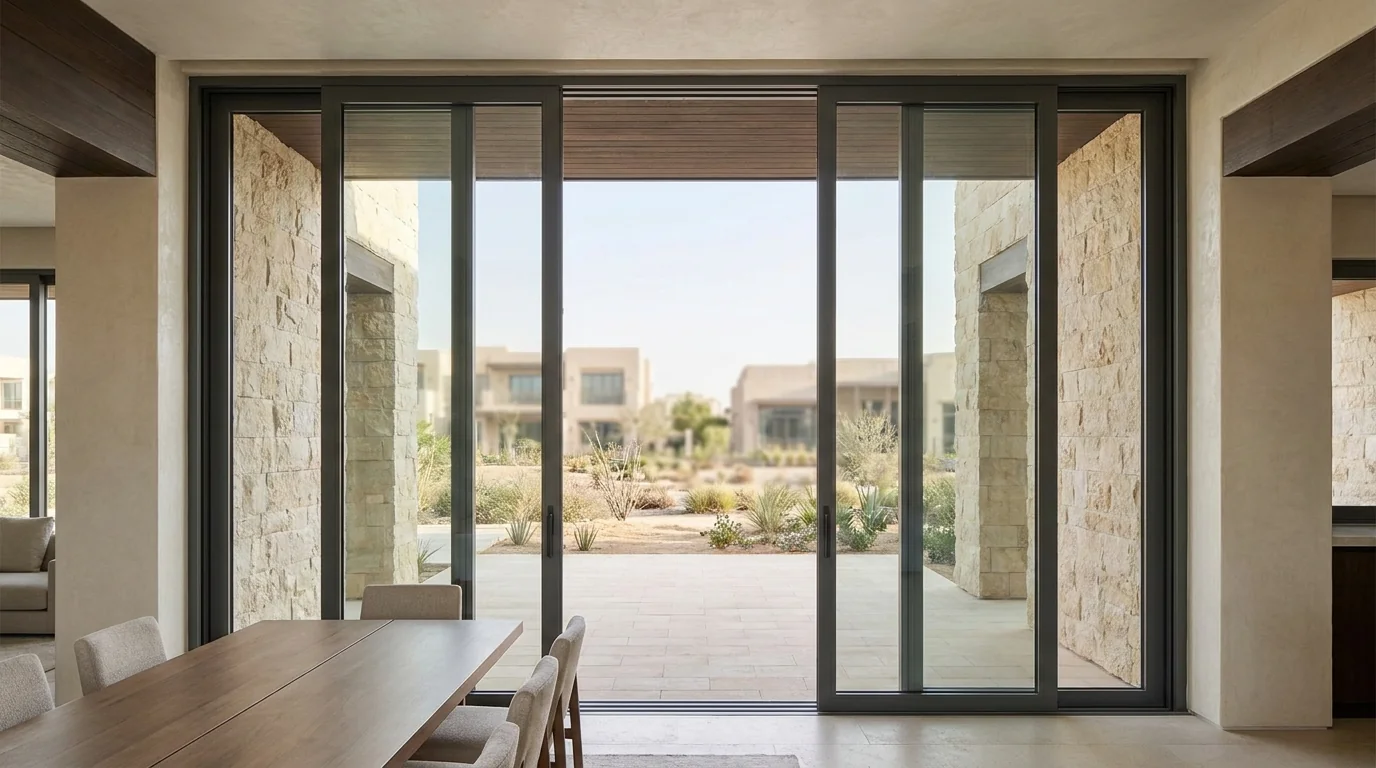
The specification that avoids most of this
Every fixable disadvantage above comes down to a line on the order. Copy this into your enquiry and the answers will tell you a great deal about who you are dealing with.
- Panel weight per leaf, calculated for the proposed glass, and the rated capacity of the gear being quoted.
- Air, water and wind classes to EN 12207, EN 12208 and EN 12210, with the test report referenced.
- Lift-and-slide or pure sliding gear, stated, with the reason.
- Glass make-up in full: thickness, toughened or laminated, coating and which surface it sits on, spacer type.
- Uw and g-value calculated for your actual panel sizes, not a brochure specimen.
- Thermally broken frame, stated explicitly.
- Locking type and number of engagement points, plus anti-lift provision.
- Threshold type, flush drained or raised, with the drainage path drawn.
- Hardware manufacturer named, so parts can be sourced later.
- Structural interfaces: head support, deflection limit and floor loading at the track.
- Warranty scope and duration, separating system, glass and hardware.
For how a quotation breaks down line by line and what is usually left out of one, see sliding glass door installation cost in Dubai.
How we handle it
We measure the opening, look at the head and the floor, check access, and tell you if a slider is the wrong product for that opening.
System, glass make-up, panel weights, gear capacity, hardware brand, threshold type and finish, in writing.
Made in our own workshop in Al Qusais Industrial First. Typically 2 to 3 weeks from approved measurements.
Our own fitters, not a subcontractor. Typically 1 to 2 days depending on size and access.
We show you the maintenance points, hand over documentation, and back it with a 10-year warranty on our aluminium systems.
See how we approach openings generally on our door installation page, or look at finished work in our projects.
Sliding glass door disadvantages: FAQs
What is the biggest disadvantage of a sliding glass door?
That only part of the opening ever clears. A two-panel sliding door opens to roughly half its width because one panel has to slide behind the other. Three-track and telescopic arrangements clear more, and a pocket system where the panels disappear into the wall clears the opening completely, but that has to be designed into the wall before it is built.
Are sliding glass doors energy efficient?
They can be, and it depends almost entirely on the glass and the frame rather than on the sliding action. A double-glazed unit with a solar-control coating in a thermally broken frame performs well in Dubai. A single-glazed unit in a plain aluminium frame does not, and good running gear will not compensate. Ask for the calculated Uw and g-value for your actual panel sizes rather than a brochure figure.
Are sliding doors safe and secure?
A properly specified one is, and a cheap one is not. Security comes from three things: multipoint locking that engages at several points up the interlock so the panel cannot be levered, anti-lift blocks that stop a closed panel being raised off its track, and laminated glass whose interlayer holds the pane together when broken. Frame thickness makes almost no difference.
Do sliding glass doors let in more heat than other door types?
Not because they slide, but because they are usually much larger. A sliding door is mostly glass by area, so the sealed unit does most of the thermal work. On a west-facing unshaded opening the glass specification matters more than any other decision on the door, and orientation should drive it elevation by elevation rather than across the whole property.
Why does my sliding door get stiff or hard to open?
Almost always grit in the bottom channel. Fine sand is rolled flat by the carriages and becomes an abrasive paste that wears the rollers. Vacuuming the track monthly with a crevice tool prevents most of it. Never put oil or grease in the channel, because it collects more sand and holds it against the rollers.
How often does a sliding door need maintenance?
Vacuum the bottom track monthly. Check the sill weep holes and wipe the gaskets quarterly. Wash the frames every six months, which matters more near the coast where salt sits on the powder coat. Have the rollers, carriages and locking checked and adjusted annually, and the seals assessed before they fail.
Are sliding doors cheaper than bifold doors?
For the same opening, glass and finish, an aluminium slider is normally less than an equivalent bifold, because a bifold has more frame, more hinges and more locking points per square metre. The gap narrows on a slim or lift-and-slide sliding system and can reverse on a pocket or telescopic arrangement. The only reliable comparison is two quotations for the same opening with the same glass specified.
Are sliding doors more expensive than hinged doors?
Per opening, usually yes, because a sliding door covers a far larger area of glass and carries running gear. Per square metre of glazed opening the difference is much smaller. Comparing a single hinged door with a four-panel slider is not a like-for-like comparison.
Can a sliding glass door be made air tight?
Not in the absolute sense, because a panel that has to move sideways cannot be compressed into its frame the way a hinged leaf is. A well specified one seals very well. Lift-and-slide gear drops the panel onto its gaskets when closed, compression seals stop air where brushes only stop dust, and multipoint locking pulls the panel into its seals along the whole height. Ask for the tested classes rather than a reassurance.
Do sliding doors leak water in heavy rain?
Only if the threshold was never designed to drain. The sill needs a channel and a weep path that takes driven rain out rather than letting it stand against the frame, formed in the slab rather than added as an accessory. Water appearing on the inside sill is usually a blocked weep hole, which is a service visit, or a threshold that was never drained, which is a design fault.
Are internal sliding doors with glass a better idea than external ones?
Most of the disadvantages of a sliding door are weather problems, so indoors they disappear: no driven rain, no solar gain, no wind loading and far less sand in the track. The specification is lighter and considerably cheaper. Two things stay true indoors: only part of the opening clears, and a sliding divider will never give the acoustic separation of a solid wall.
When should I not choose a sliding door?
When the whole span has to clear, when a room has to be acoustically separated, when the opening sits on a designated escape route, when it needs a fire rating, or when nobody will maintain the tracks. In each of those cases a folding, telescopic or hinged door is the right product and we will say so at the survey.
Not sure a slider is right for your opening?
Send us the opening size and what the space is used for. We will come and measure it, and if a sliding door is the wrong answer we will say so and tell you what is. Our own team measures, supplies and installs. See the full range of door services.
DreamFold · Al Qusais Industrial First, Dubai · Monday to Saturday 8:00–19:00 · contact@dreamfold.ae