
Sliding Door Repair in Dubai
Sliding doors that drag, grind, jump off the track or won’t lock are almost always fixable. We repair aluminium sliding doors, lift-and-slide systems, slim-frame and telescopic sliders for villas, apartments and offices. Rollers, tracks, locks, handles and seals are replaced with parts matched to your system.
Why sliding doors fail in Dubai
Most balcony and patio sliders are bottom-rolling: the whole panel rides on a pair of small rollers in the bottom track (how sliding doors work). A large glass panel can weigh well over 100 kg, and in Dubai those rollers work in fine sand that blows into the track, with heat that makes the frame expand and contract every day.
Over time the bearings wear, the wheels flatten, the track gets scored and the panel drops slightly out of line. That is when the door starts to drag, rattle or refuse to lock. The frame and glass usually outlast the moving parts by many years, so replacing rollers, repairing the track and re-setting the panel brings most doors back to a smooth, one-finger slide.
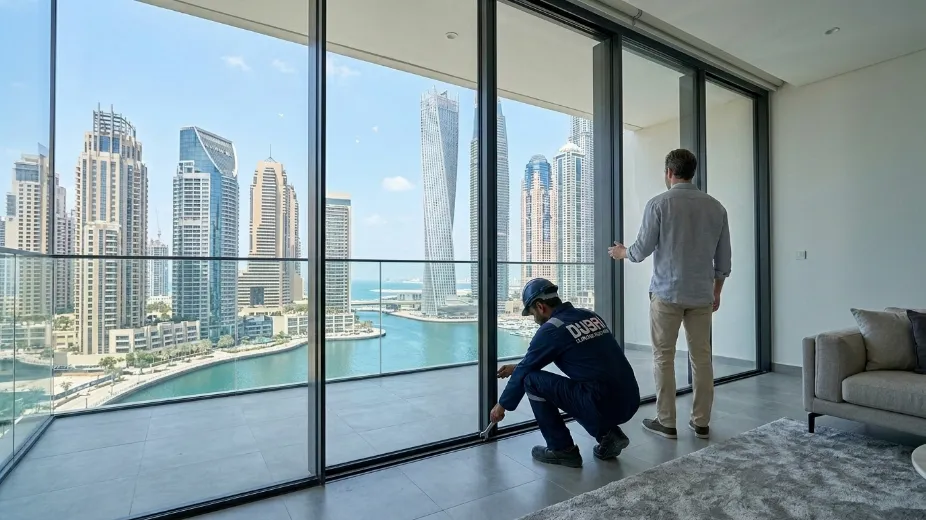
Sliding door problems and what fixes them
| Problem | Usual cause | Repair |
|---|---|---|
| Heavy to open, needs two hands | Flattened rollers or seized bearings | New roller set, track cleaned |
| Scraping or grinding noise | Sand in the bearings, scored track | Rollers replaced, track insert or section renewed |
| Panel comes off the track | Worn rollers, missing anti-lift blocks, bent track lip | Rollers and anti-lift blocks fitted, track straightened |
| Hook lock won’t catch | Panel has dropped, keep out of line, worn lock | Panel re-levelled, keep adjusted or lock replaced |
| Door rolls open or closed by itself | Rollers set at different heights, track not level | Roller height re-set, track levelled |
| Rattles or whistles in the wind | Worn interlocks and brush strips | Interlock seals and brush strips renewed |
| Dust and hot air getting in | Perished weather seals and brush pile | Seals and brush strips replaced |
| Water sitting in the track or coming inside | Blocked drainage slots | Drainage cleared, track sealed where needed |
| Mist between the two panes | Sealed double-glazed unit has failed | Glass unit replaced, frame kept |
| Lift-and-slide handle won’t lift or lower the panel | Worn gear or carriage in the lift mechanism | Gear or carriage replaced and adjusted |
| Soft-close stopped working | Damper worn or out of position | Damper replaced and re-set |
Dust, hot air and water getting in
A closed sliding door should keep out sand, air-conditioning losses and rain. When it doesn’t, the rollers are rarely to blame. The seals and the drainage are.
Sand and dust through a closed door
Sliding panels don’t press shut like a hinged door. They rely on brush strips (weather pile) along the frame and an interlock where the two panels meet. The pile flattens and the interlock seal wears, so gaps open up. On high floors the wind pushes dust through those gaps and you hear whistling. We replace the pile and interlock seals to the original size and check the panel sits tight against them.
Water coming in under the door
The bottom track has small drainage slots that let rainwater run out to the balcony. When sand blocks them, water builds up in the track and spills inside during heavy rain or when the balcony is washed. We clear the slots, fit new drainage covers where they’re missing and seal the track joints so the water goes out, not in.
Sliding doors we repair
Standard aluminium sliders
Two, three and four-panel doors onto balconies and terraces, the most common type in Dubai apartments and villas.
Lift-and-slide doors
Heavy panels that lift off their seals when you turn the handle. We repair the gear, carriages and seals.
Slim and minimal-frame doors
Large panes on thin frames need precise roller and track work to stay smooth. See our ultra-slim sliding doors.
Telescopic and multi-slide doors
Several panels on parallel tracks that pull each other along. We re-set the catches and rollers on every panel of multi-slide telescopic doors.
Pocket (cavity) sliding doors
Doors that slide into the wall. We repair the top track, hangers and floor guides.
Sliding office and partition doors
Glass sliding doors in offices and shops, including top-hung systems and their end stops, and doors in glass partitions.
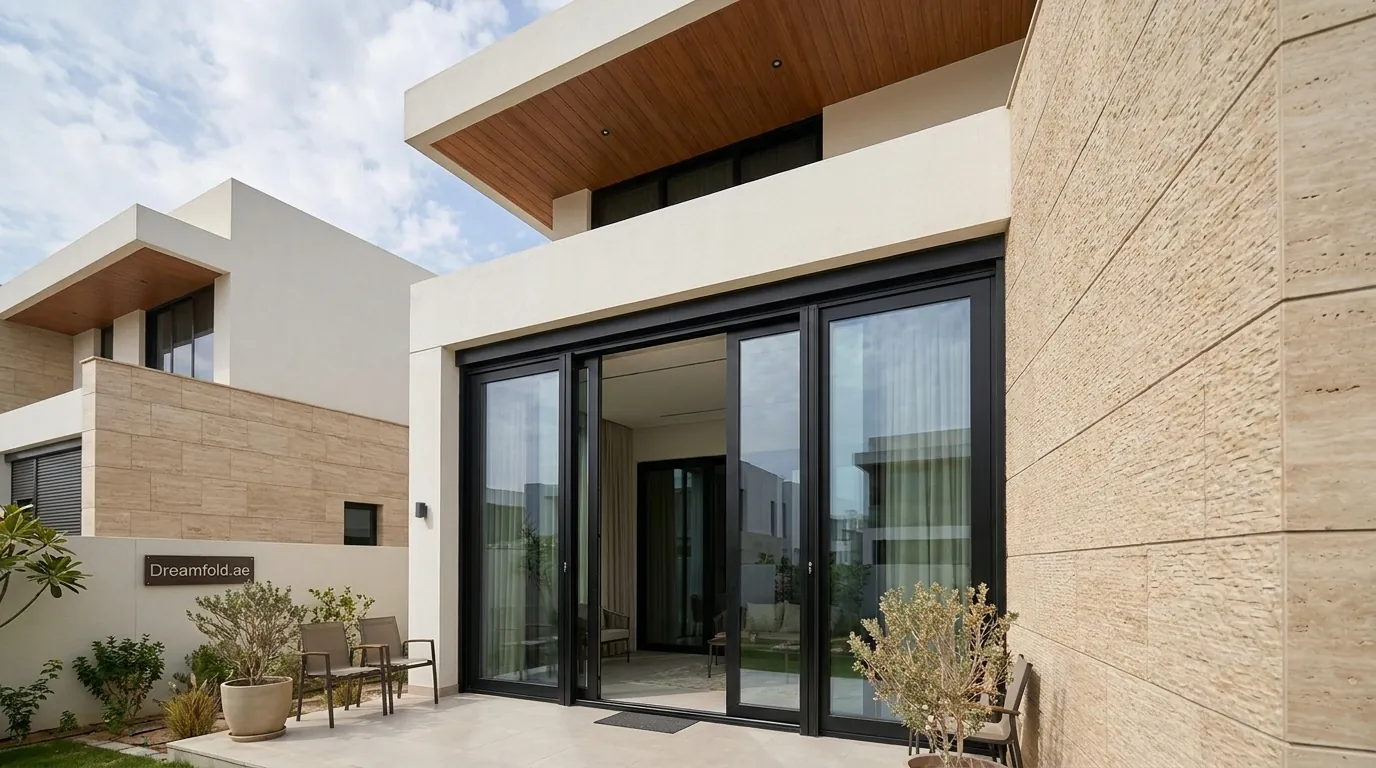
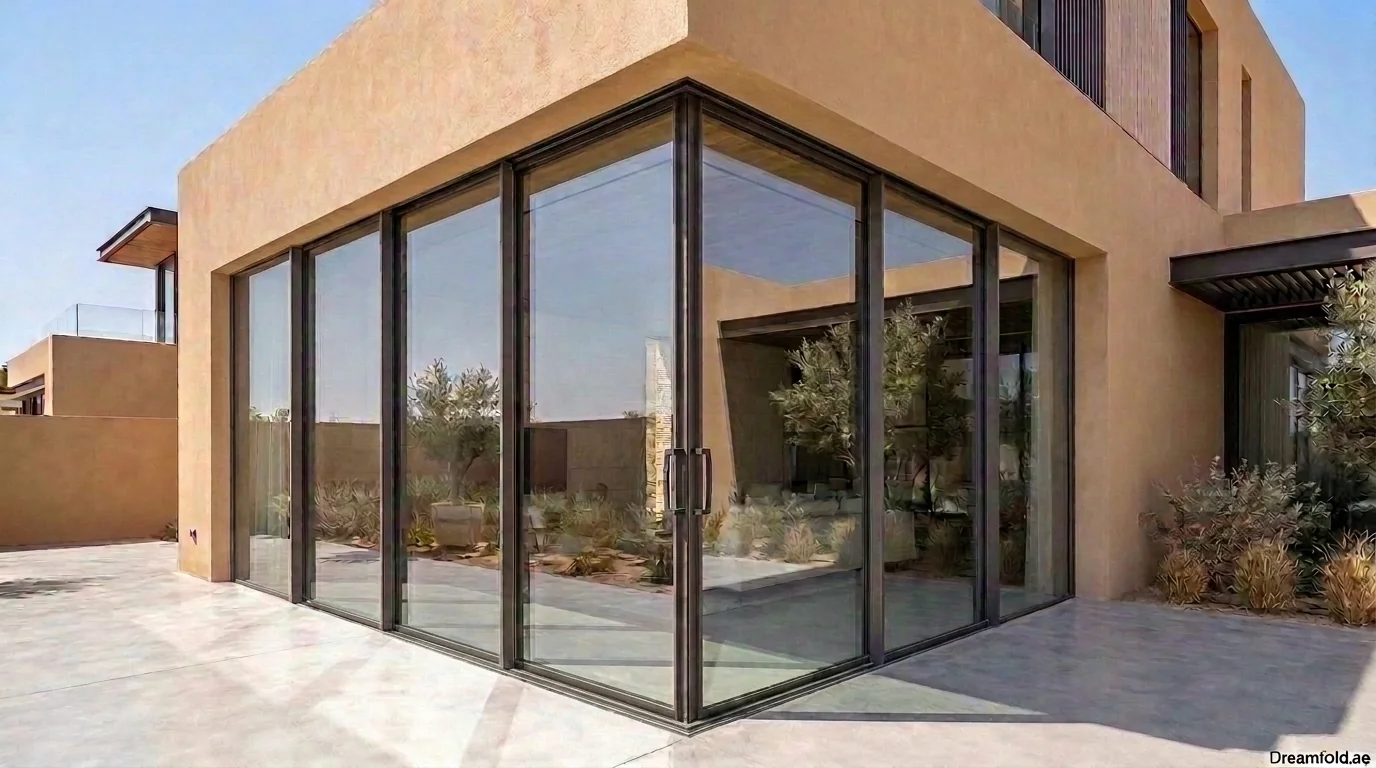
Sliding door parts we replace
Rollers
Single, tandem and adjustable rollers in steel or nylon, sized to the panel weight. Heavy doors get tandem rollers so the load is shared.
Tracks and track inserts
Scored or dented bottom tracks are cleaned, straightened or fitted with a new stainless insert or section. Top guides are replaced when panels wobble.
Hook locks and keeps
The hook lock is the most common sliding door lock. We replace worn locks and cylinders and adjust the keep so it catches without forcing the handle.
Handles
Flush pulls and lever handles replaced in a matching finish, including lift-and-slide handles.
Interlocks, seals and brush strips
The interlock where the panels meet and the brush strips along the frame keep out dust, wind noise and heat. They wear out long before the frame does.
Anti-lift blocks, end stops and dampers
Small parts that stop the panel lifting out, hitting the frame or slamming. Missing ones are a common reason doors come off the track.
Sliding door locks and handles
When a sliding door won’t lock, the lock itself is often fine. The panel has usually dropped a few millimetres, so the hook no longer lines up with the keep on the frame.
Single hook locks
A hook swings up into a keep on the frame. If the handle turns but the door still opens, we re-level the panel and move the keep before replacing anything.
Multi-point hook locks
Two or more hooks along the edge, found on larger and newer doors. One worn hook or a slipped connecting rod stops the whole lock. We replace the lock body to the original size.
Key cylinders and lockable handles
Worn, stiff or lost-key cylinders are swapped for new ones, and lockable handles are fitted where children or security are a concern.
Secondary locks and anti-lift
Extra floor or frame bolts and anti-lift blocks stop a closed panel being lifted out of the track from outside. More on sliding door security.
Carriers, gearboxes and the parts nobody else changes
Most sliding door callouts in Dubai get fixed with a squirt of lubricant and a promise. That works for about three weeks. The parts below are the ones that actually wear out, and they are the reason a door comes back. Where a frame is past saving, replacing the panels is covered on our sliding doors in Dubai page, and wide multi-panel openings on telescopic sliding doors.
Carriers and bogies
The wheel assemblies the panel hangs or rides on. They are sized by panel weight, not by track width, so a 120 kg leaf on a 80 kg carrier will fail again whatever is fitted. We match the carrier to the glass weight, not to what is in the van.
Lift-and-slide gearbox
On a lift-and-slide the handle turns 180 degrees to drop the panel onto its seals and lift it back onto the rollers. When that gearbox wears, the door still moves but never seals, so the room stays dusty and the AC works harder.
Anti-lift blocks and top guides
The small stops that keep a panel from being lifted out of the track. Missing or broken ones are a security hole as much as a rattle, and they are usually the cheapest part on the door.
Soft-close dampers
The cylinder that catches the panel in the last 100 mm. When it fails the door slams onto the jamb, and repeated slamming is what cracks the corner of a toughened panel months later.
Seals, brush pile and the weather line
Dust and hot air come through the seal line, not the glass. There are three separate seals on a typical sliding door and they fail at different rates.
- Interlock brush pile the fin-and-brush strip where two panels overlap. It flattens with use and is the first thing to go in a sandy year.
- Frame gaskets the EPDM or TPE profiles in the outer frame. They harden in UAE heat and shrink back from the corners, which is where the draught starts.
- Threshold drainage the slots in the bottom track that let rain out. Blocked slots are why water appears inside after the first rain of the season, and clearing them is not the same job as re-sealing.
Seals are profile-specific. A gasket that looks identical will not hold if the bulb diameter or the spine width is wrong, so we match the profile before ordering rather than fitting a universal strip.
What happens during a sliding door repair
- Slide test. We move the door, check it’s level and listen for where it drags.
- Panel out. The panel is lifted off the track so the rollers and track can be inspected properly.
- Track work. Sand is cleared, drainage slots opened and damaged track straightened or fitted with an insert.
- New parts. Rollers, seals, lock or handle are fitted to match your system.
- Set and test. Roller height is adjusted, the lock keep lined up and the door tested until it slides and locks cleanly.
Most roller, lock and seal jobs are finished in one visit. Glass and some lift-and-slide parts need a second visit once the part is ready.
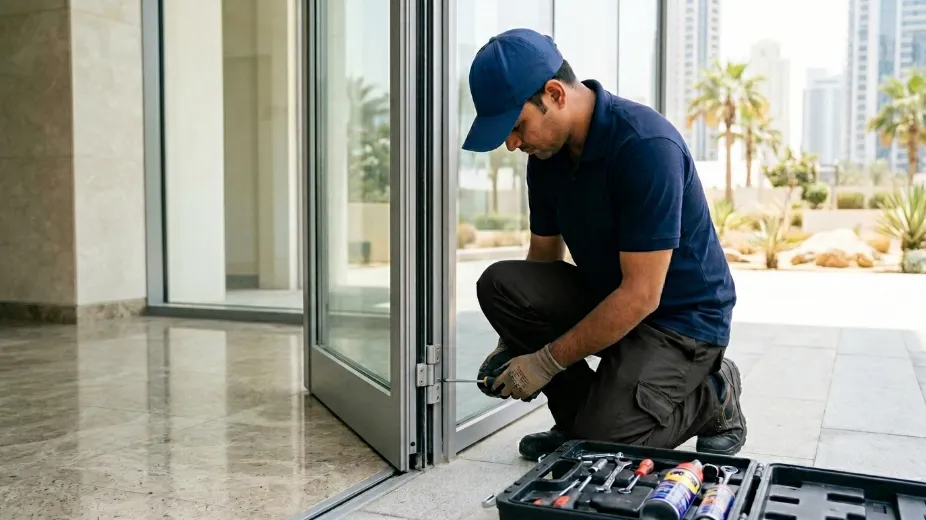
Sliding door repair prices in Dubai (2026)
Typical prices, including the visit, labour, parts and a 6-month warranty. We confirm the price from your photos before booking.
| Job | Typical price (AED) |
|---|---|
| Track deep cleaning and lubrication | 150–250 |
| Roller replacement, per panel | 200–400 |
| Panel re-alignment | 200–350 |
| Seal and brush strip replacement, full door | 300–500 |
| Handle replacement | 250–450 |
| Lock repair or replacement | 300–600 |
| Glass replacement, 8–12mm toughened, per m² | 500–800 |
Lift-and-slide gear, telescopic systems and large panels are quoted from photos, as parts depend on the system.
Repair or replace your sliding door?
Repair makes sense when
- The frame is straight and not corroded
- The problem is rollers, track, seals, lock or handle
- The glass is intact, or only one pane is damaged
Replacement makes sense when
- The frame is bent, pitted or badly corroded by salt air
- The track is part of a damaged frame and can’t be renewed
- You want better insulation, slimmer frames or a wider opening
For a new door, see our sliding doors in Dubai.
Keep your sliding door running smoothly
Weekly in dusty months
Clear the track
Vacuum the bottom track before the sand works into the rollers. A clean track is the cheapest repair there is.
Every few months
Silicone, not oil
Use a dry silicone spray on the track and rollers. Oil and grease hold sand and turn it into a grinding paste.
Once a year
Professional service
Carrier wear, height adjustment, lock alignment and a full seal inspection, with the track cleared and the drainage slots flushed. Coastal and open-desert villas usually need this twice a year rather than once.
Quick checks before you call
Safe to do yourself
- Vacuum the track and look for stones, screws or broken plastic in it
- Check the drainage slots on the outside track aren’t full of sand
- Close the door fully and see whether the lock hook reaches the keep
- Note where it sticks: one spot usually means the track, the whole length usually means rollers
Leave to a technician
- Lifting a panel out: large panels are heavy and the glass can be damaged
- Adjusting roller height on double-glazed or lift-and-slide doors
- Forcing a hook lock that won’t turn
- Any cracked or loose glass
Sliding door repair FAQs
Why is my sliding door so hard to open?
Usually the rollers are worn or full of sand, or the panel has dropped and is rubbing on the track. Cleaning the track sometimes helps, but worn rollers need replacing.
Can sliding door rollers be replaced?
Yes. Rollers are a standard replacement part. We lift the panel out, fit a matching roller set and adjust the height so the door runs level.
Why does my sliding door keep coming off the track?
Worn rollers, a bent track lip or missing anti-lift blocks. We replace the rollers, straighten or renew the track and fit anti-lift blocks so the panel can’t jump out.
Why won’t my sliding door lock?
Most often the panel has dropped and the hook no longer meets the keep. Re-levelling the panel and adjusting the keep fixes it. If the hook itself is worn or the handle turns without moving it, the lock is replaced.
Why do dust and hot air come through my closed sliding door?
The brush strips along the frame and the interlock seal where the panels meet have worn flat. New pile and interlock seals, with the panel set tight against them, close the gaps.
Why does water come in under my sliding door?
The drainage slots in the bottom track are blocked with sand, so water builds up and spills inside. Clearing the slots and sealing the track joints lets it drain out.
Should I oil or grease my sliding door track?
No. Oil and grease trap sand and wear the rollers faster. Vacuum the track, wipe it clean and use a silicone spray instead.
How much does sliding door repair cost in Dubai?
Most jobs cost AED 150–600. Roller replacement is AED 200–400 per panel and lock replacement is AED 300–600. We confirm the price from your photos first.
How often should a sliding door be serviced?
Clean the track yourself regularly and book a professional service once a year. Doors facing the sea or open sand benefit from a service every six months.
Do you repair lift-and-slide and telescopic doors?
Yes. We repair the lift gear, carriages, seals and catches on lift-and-slide and multi-panel telescopic doors.
Where we repair sliding doors
From Al Qusais we cover all of Dubai, including apartment towers in Dubai Marina, JBR, JLT, Downtown and Business Bay, and villas in Arabian Ranches, Dubai Hills Estate, Jumeirah, Mirdif and Al Barsha. Visits to the other emirates are booked in advance.
Other glass door repairs
For folding, pivot, frameless and office doors and aluminium windows, see our main glass door repair page. For bathroom enclosures, see shower glass door repair.
Get your sliding door gliding again
Send a short video of the door moving on WhatsApp. We’ll tell you the likely cause and the price before anything is booked.