
Telescopic Sliding Doors in Dubai
Telescopic sliding doors move several panels together on multiple tracks so they stack behind each other, clearing most of a wide opening instead of half of it. We design, fabricate and install them across Dubai and the UAE — three to six panels and more, internal or external, manual or automatic.
Measured and quoted after a free site visit · 10-year warranty on our aluminium systems
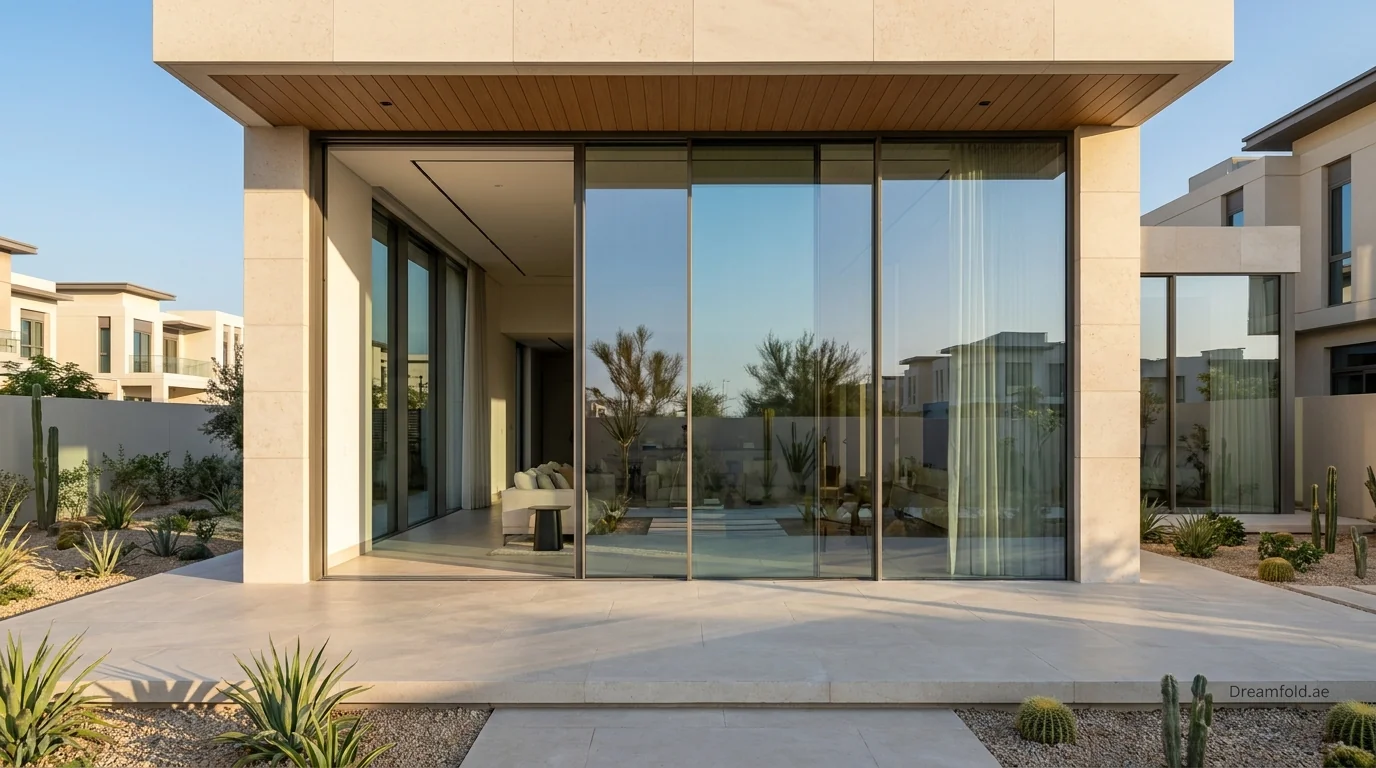
How a telescopic multi-slide door works
A standard slider has one panel passing another on two tracks, so at best half the opening clears. A telescopic multi-slide system puts each panel on its own track and links them, so they travel together and nest behind each other at one end.
The effect is that a three-panel telescopic run clears roughly two thirds of the opening, a four-panel run about three quarters, and a pocketed telescopic run clears it completely. You get the clear opening of a folding door without a stack of frames standing in the doorway.
The trade is that every extra track adds an interlock to the closed view and a channel to keep clean. That is the honest arithmetic of this system, and it is why a telescopic door is the right answer for a wide span and the wrong answer for a narrow one.
The parts that do the work
- Multi-track sill and head. Two, three or four tracks running the length of the opening, each carrying one panel.
- Carriages and rollers. Rated in kilograms, chosen against the calculated weight of the panel they carry.
- Synchronising gear. The mechanism that makes the panels move together rather than one at a time.
- Interlocks and seals. Where panels meet each other and the jambs when closed.
- A drained threshold. One long channel that has to take driven rain out along its whole length.
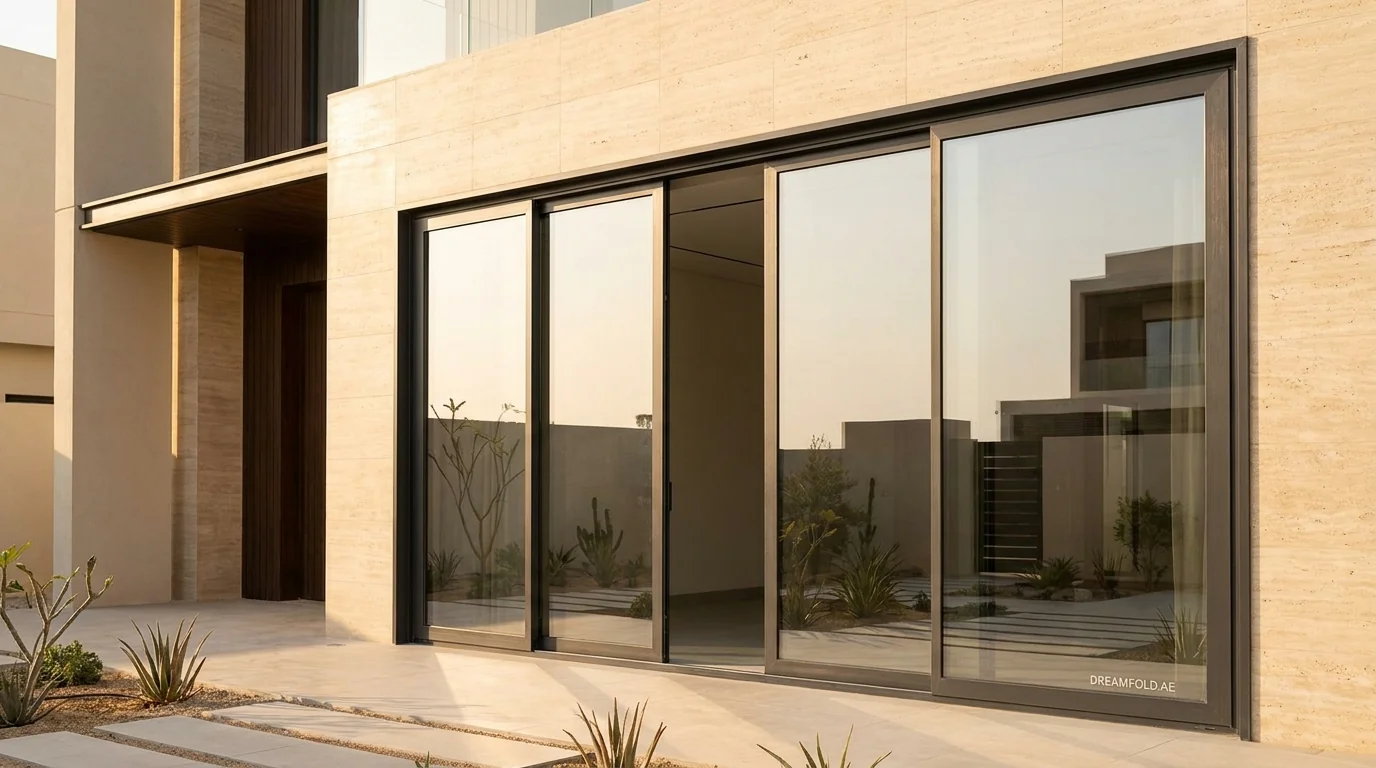
Synchronisation: why one handle moves the whole set
This is the part people find surprising. In a synchronised telescopic system you pull one leading panel and the rest follow, each travelling at a different speed so they all arrive stacked together.
Synchronised multi-slide
A belt or cable arrangement links the panels. Pull the lead panel and the others move proportionally. One handle, one motion, and the panels always end up evenly stacked.
Independent
Each panel is moved by hand in sequence. Simpler and cheaper, with fewer parts to service, but it takes several movements to open the span.
Motorised
A drive on the lead panel moves the whole synchronised set. On heavy glass this is often the only comfortable option, and it is essential on commercial entrances.
Synchronised gear is what makes a wide telescopic run feel effortless rather than like work. It is also the part that needs the track kept clean, because added friction anywhere in the run is felt at the handle.
Multi-slide tracks, panels and stacking layouts
The layout decides where the panels end up when open, and that is usually dictated by the wall you have available beside the opening.
| Layout | Tracks | Roughly how much clears | Notes |
|---|---|---|---|
| Three panel, one direction | 3 | About two thirds | The most common villa arrangement. All panels stack at one jamb. |
| Four panel, one direction | 4 | About three quarters | Wide terraces. Needs stacking depth at one end and a deeper frame. |
| Bi-parting, three each side | 3 + 3 | About two thirds, from the centre | Symmetrical elevations and commercial frontages. Opens from the middle. |
| Six panel, one direction | 6, or fewer with a fixed light | Most of a very wide span | Atria, showrooms and restaurant frontages. Structural coordination is essential. |
| Pocketed telescopic | 3 or 4 | Effectively all of it | The stack disappears into a wall cavity. Best result, and it must be designed into the wall. |
| Telescopic plus fixed light | 2 or 3 | Part of the span | A fixed pane takes the rest of the elevation. Cheaper per square metre and seals better. |
| Corner telescopic | Varies | Two elevations | Two runs meeting at an open corner. The head detail carries everything. |
If your opening only needs half of it to clear, or the closed view matters more than the clear width, a two-panel slim slider is usually the better and cheaper answer — see ultra-slim sliding doors.
Extra-wide openings: what actually limits the span
There is no single maximum width. Four separate things cap the span, and whichever of them is lowest decides the answer for your opening.
Every carriage has a published capacity in kilograms. Your glass make-up sets the weight, and the gear has to be rated comfortably above it.
The longer the opening, the more the structure above can sag. Telescopic runs have very little tolerance for it, so the lintel or movement head has to be sized for the span.
Panels have to go somewhere. A four-panel run needs roughly a panel's width of wall or pocket at one end, and if that wall does not exist the layout has to change.
There is a practical ceiling on the size of a single insulated unit, and a separate question of whether it can physically reach your opening — stairs, lifts, gates, or a crane.
Panel weight, gear and structure
A telescopic run is the heaviest sliding arrangement we build. More panels, larger panes and multiple tracks all add load, and the structure has to carry it.
- Weight is calculated, not estimated. Glass thickness, laminate interlayers, coating and the number of leaves give an exact figure in kilograms per panel.
- Gear is rated above that figure, not at it. Gear specified at the panel weight runs sweetly at first, then stiffens, then the panel drops off level. It is the fault we are called out to most often on sliding systems.
- Point loads land in the slab. A multi-track sill concentrates load along the track line. On upper floors, terraces and cantilevered slabs this is a question for the structural engineer.
- The head must not deflect. A movement head or a properly sized lintel keeps the structure above off the panels.
- Thermal movement. A long run of dark aluminium in Dubai sun grows measurably. Expansion has to be allowed for at the perimeter or the panels bind in August.
Where work alters an external opening, a lintel or the facade, the requirements are set out in the Dubai Building Code published by Dubai Municipality. In an apartment or managed community the developer or owners association will have its own approval process. We raise both at the survey.
Automatic telescopic doors
Telescopic gear is used on commercial entrances as well as villa terraces, and there the doors are almost always automatic. The stacking action is what lets a wide clear entrance fit into a narrow shopfront.
Why telescopic for entrances
Two panels each side stack in half the wall space a single sliding leaf would need, so you get a wide clear entrance without a long side screen.
Sensors and safety
Activation and safety sensors, obstruction detection and a controlled closing speed are part of the specification, not extras.
Escape and break-out
Where the entrance sits on an escape route, break-out panels and the fail position in a power cut have to be agreed with the authority and the building management.
Power and controls
Power to the head before the ceiling closes, plus access control, keypads or building-system integration if wanted.
Automatic entrances on shopfronts, showrooms and hotels are covered in full on our commercial doors in Dubai page, and office-side openings on office doors.
Internal telescopic sliding doors
Telescopic systems are not only for terraces. Indoors they solve a specific problem very neatly: dividing a large room without losing floor space to a swinging leaf or a stack of folding panels.
- Much lighter specification. No weather, wind or thermal performance to pay for, so single toughened glass in a lighter frame is both correct and considerably cheaper.
- Ceiling-hung options. Where the floor cannot be cut, an internal run can be carried from the structure above, leaving a clean floor with no track to trip on.
- Room dividers. A living and dining space that becomes one room for a gathering, or a majlis that closes off when needed.
- Meeting rooms and boardrooms. A glazed wall that opens fully for a presentation or an event — often combined with glass partitions.
- Privacy on demand. Internal runs are a natural fit for switchable smart glass, which turns clear to opaque at a switch.
- Acoustics are the limit. A sliding divider will never be as quiet as a solid wall. Where sound matters, say so at the survey and we will tell you honestly what it will and will not do.
Glass, heat and comfort
A telescopic run is a very large area of glass, which means the glass specification matters more here than on any smaller opening. This is where the budget should go first.
Double glazed, always
On any external opening in Dubai. The sealed cavity is what stops the heat, and a single-glazed run this size would be unliveable in summer.
Solar control coating
A low-emissivity or solar-control coating on the outer leaf rejects a large part of the sun's energy before it reaches the cavity. Which surface it sits on changes the result.
Laminated where people are
Toughened glass breaks safely; laminated holds together and stays in the frame. Beside a pool or where children play, laminated is the sensible call.
Acoustic interlayers
Worth it on a road-facing frontage or a restaurant terrace, and not worth it on a quiet garden.
Weight consequences
Every one of the above adds kilograms, and kilograms drive the gear. This is why glass and hardware have to be specified together, not one after the other.
Numbers, not adjectives
We put the Ug, Uf, Uw and g-value for your actual panel sizes on the quotation rather than quoting a brochure figure.
Sealing a multi-track run
More panels means more interlocks, and every interlock is a joint that has to seal. This is the honest weakness of the system and the place where good engineering shows.
- Ask for the tested classes. Air permeability is classified under EN 12207, watertightness under EN 12208 and wind resistance under EN 12210. A test report beats a reassurance.
- Compression matters more than brushes. Brush seals stop dust; compression gaskets stop air. Locking that pulls the panels into their seals along the full height is what makes the closed position consistent.
- Every track needs draining. A multi-track sill has several channels, and all of them have to shed water. Blocked weep holes on one channel will show up as water on the inside sill.
Thresholds, floors and access
On a wide run the threshold is a long, continuous detail rather than a short one, which changes what it has to do.
| Detail | Why it matters on a telescopic run |
|---|---|
| Flush versus raised | A level threshold makes inside and outside read as one space. On a long run it needs a drained sill formed in the slab with a consistent fall along its whole length. |
| Drainage capacity | More channels and a longer run mean more water to shed. Weep spacing and outlet positions have to be designed, not assumed. |
| Floor level and fall | A screed that is flat in one bay and falling in the next will show as a tapering gap along a slim frame. |
| Stacking zone | The wall or pocket where the panels come to rest has to be clear of switches, sockets and radiators, and reachable for servicing. |
| Delivery route | Large panels have to reach the opening. We check stairs, lifts, gates and turning circles at survey, before anything is made. |
| Working space | Fitting a long multi-track sill needs the opening clear and level. Coordinating that with the builder saves a return visit. |
Telescopic against the alternatives
Telescopic is the right answer for a wide opening that needs most of itself to clear. For other priorities, something else wins.
| Option | Strongest at | Trade-off |
|---|---|---|
| Telescopic multi-slide | Wide spans, most of the opening clears, no stack of frames in the doorway | More tracks to keep clean, heavier gear, more interlocks when closed |
| Ultra-slim sliding | Cleanest closed view, largest panes | Only about half the opening clears unless pocketed |
| Standard sliding | Cost and proven detailing | More frame in the view, half the opening clears |
| Bifold / folding | Clears almost the entire span | A concertina of frames stands at the jamb when open — compared in bifold versus sliding doors |
| Fixed glazing plus a door | Best sealing, lowest cost per square metre | The wall does not open |
Where telescopic doors earn their place
Wide villa terraces
The classic case: a living room that opens onto a garden or pool along most of its width, without a stack of folding frames in the way.
Restaurant and cafe frontages
A frontage that opens fully in the cooler months and seals properly in summer. Usually bi-parting so service can pass through the centre.
Showrooms and atria
Very wide clear openings for moving stock and vehicles, often motorised.
Automatic entrances
Stacking panels fit a wide entrance into a narrow shopfront — see commercial doors.
Internal room dividers
Living-to-dining, majlis and boardroom divisions, at a much lighter specification.
Penthouse terraces
Exposure rises with height, so the wind class and head detail matter more here than anywhere else.
What affects the cost of telescopic sliding doors
We quote after measuring, because the span, the structure and the stacking zone are the three largest cost factors for a multi-slide run and none of them can be judged over the phone. These are the decisions that move the figure.
Span and panel count
Area drives everything, and each extra track adds sill, head and gear.
Glass build-up
Coating, laminate, acoustic interlayer and thickness, over a very large area. Usually the largest line.
Synchronised or independent
Synchronising gear costs more and is far nicer to use on a wide run.
Motorisation
Drive, controls, safety sensors and the power supply to the head.
Pocketing
A stacking cavity in the wall is builder's work as well as ours.
Threshold
A flush drained sill along a long run needs real work in the slab.
Structural work
Lintels, movement heads and head support, quoted separately and honestly.
Access and lifting
Getting large panes to a terrace can need a lift, a crane or extra labour.
For how an installed sliding price breaks down line by line, and what quotations usually exclude, see sliding glass door installation cost in Dubai. If the budget is fixed, affordable glass door options sets out which compromises are sensible and which are not.
From survey to finished opening
We measure the span, look at the head, the slab and the stacking zone, and check the delivery route.
System, track count, glass make-up, panel weights, gear capacity, synchronisation, threshold type and finish, all in writing.
Where the head or slab needs attention we say so before production, and work with your engineer or builder.
Made in our own workshop in Al Qusais Industrial First. Typically 2 to 3 weeks from approved measurements.
Our own fitters, typically 1 to 2 days depending on span and access, then documentation and a 10-year warranty on our aluminium systems.
See how we handle openings generally on our door installation page, or finished work in our projects.
Keeping a telescopic door running
More tracks means more cleaning, and that is genuinely the whole difference. A telescopic run is not more fragile than a two-panel slider — there is simply more channel to keep clear of sand.
Vacuum every channel with a crevice tool, along the full length and into both ends. Do not wash sand down into them.
Check all weep holes are clear, wipe the gaskets and brushes, and check the locking still engages cleanly on every panel.
Wash the frames with mild soap and water — important near the coast where salt sits on the powder coat.
Have the carriages, synchronising gear and locking checked and adjusted, and the seals assessed and replaced before they fail.
Telescopic door problems and what causes them
The faults we attend most often on multi-track runs, and the underlying cause of each.
| Symptom | Usual cause | What it needs |
|---|---|---|
| Panels no longer stack evenly | Synchronising belt or cable has slipped or stretched | Re-tension and re-set the synchronisation |
| Whole set getting heavy to pull | Grit in one or more channels adding friction across the run | Clean every track, inspect and adjust rollers |
| One panel drags while others move | Roller height out of adjustment on that panel | Re-level that panel and check its carriage |
| Dust line inside along the sill | Flattened brush seals or a blocked channel | Replace brushes, clear the weeps |
| Water on the inside sill after rain | One drainage channel blocked, or the fall is wrong | Clear the sill; if the detail was never drained, correct it |
| Whistling in wind | Hardened gaskets or interlocks not compressing | Replace gaskets and adjust locking engagement |
| Motorised run stops mid travel | Obstruction detection triggering on increased friction | Clean and service the tracks before touching motor settings |
| Panels bind in summer only | Thermal expansion with no allowance at the perimeter | Re-set clearances; a design issue rather than a fault |
Most of these are a service visit rather than a replacement — see sliding door repair in Dubai. We attend systems we did not install.
Specification and related reading
- The technical guide. Interlock widths, panel weight against gear capacity, EN test classes, Uw and g-value and a specification checklist — in ultra-slim sliding systems in the UAE.
- The profiles and hardware. We fabricate with Schüco and AluK systems, with gear and locking from Roto, Siegenia or GU.
- Finishes. Different shades inside and out, or matched to a community rule — see dual colour aluminium.
- Planning a whole property? Start with the door buying guide, then the full range of services.
Telescopic sliding doors: FAQs
What is a telescopic sliding door?
It is a sliding door where each panel runs on its own track and the panels are linked so they travel together and nest behind each other at one end. That lets a three-panel run clear roughly two thirds of the opening and a four-panel run about three quarters, instead of the half a standard two-track slider gives you.
How wide can a telescopic sliding door be?
There is no single figure. Four things cap the span and the lowest one wins: the panel weight against the rated gear capacity, how much the structure above can deflect, how much wall or pocket you have for the panels to stack into, and whether the glass can physically be delivered to the opening. We work all four out at survey.
Do all the panels move together?
In a synchronised system, yes. A belt or cable links the panels so you pull the lead panel and the rest follow at proportional speeds, arriving evenly stacked. Independent systems are cheaper and simpler but need each panel moved by hand in turn.
Can telescopic sliding doors be automated?
Yes, and on commercial entrances they almost always are. The motor drives the leading leaf and the synchronising gear carries the rest of the set with it. It needs power routed to the head before the ceiling is closed, plus activation and safety sensors and an agreed fail position in a power cut.
Are there internal telescopic sliding doors?
Yes, and indoors they are considerably cheaper because there is no weather, wind or thermal performance to pay for. Single toughened glass in a lighter frame is correct internally, and where the floor cannot be cut the run can be hung from the structure above so there is no floor track at all.
Do telescopic doors leak more because of the extra tracks?
Not if they are specified and installed properly, but there is more to get right: more interlocks to seal and more channels to drain. Ask for the tested classes rather than a reassurance — air permeability to EN 12207, watertightness to EN 12208 and wind resistance to EN 12210.
Can I have a flush threshold on a wide telescopic run?
Yes, provided the sill is a drained type with a consistent fall along its whole length, formed in the slab. On a long run the drainage has to be designed rather than assumed, because there is more water to shed and more channels to shed it from.
Where do the panels go when the door is open?
They stack behind each other at one end of the opening, so you need roughly a panel's width of clear wall there. If that wall does not exist, the options are a bi-parting layout that stacks at both ends, or a pocket cavity built into the wall.
Are telescopic doors harder to maintain?
Not harder, just more of the same. Every channel needs vacuuming monthly rather than one, because sand in any track adds friction that you feel at the handle. Never put oil or grease in the tracks — it collects sand and turns into grinding paste.
Telescopic or bifold for a wide opening?
A bifold clears slightly more of the span but leaves a concertina of frames standing at the jamb. A telescopic run leaves the doorway clear and has fewer moving joints, but keeps some panel width at one end. For a walkway or a serving frontage, telescopic usually wins.
How much do telescopic sliding doors cost in Dubai?
It depends on the span, the number of panels and tracks, the glass make-up, whether the gear is synchronised or motorised, the threshold type, any pocket cavity, the finish and any structural work. We quote in writing after a free site visit, because the span and the structure cannot be judged remotely.
Why have my panels stopped stacking evenly?
Almost always the synchronising belt or cable has slipped or stretched, which is a re-tension and re-set rather than a replacement. If the whole set has also become heavy to pull, there is usually grit in one or more channels adding friction across the run.
Get a quote for a telescopic sliding door
Send us the span and we will come and measure it. You get a written quotation with the track count, the glass make-up, the panel weights, the gear capacity and the threshold detail on it. Our own team measures, supplies and installs — see our completed projects.
DreamFold · Al Qusais Industrial First, Dubai · Monday to Saturday 8:00–19:00 · contact@dreamfold.ae · manufacture 2–3 weeks, installation 1–2 days