
Dual Colour Aluminium in Dubai: Two Finishes, One Frame
Dual colour — also called two-tone or bicolour — lets the outside of a door or window frame match the facade while the inside matches the room. Dark anthracite outside, warm white or wood-effect inside, or any other pairing across the RAL range.
Available across our bifold, sliding, pivot and window systems

What dual colour aluminium actually means
A dual colour frame carries one finish on the face you see from outside the building and a different finish on the face you see from inside the room. It is one frame, coated in two colours, decided before anything is made.
The reason it exists is simple: the two sides of a door have two different jobs. Outside, the frame belongs to the facade — it sits against render, stone or cladding and usually wants to recede or to read as a deliberate dark line. Inside, the same frame sits against a wall colour, joinery and flooring chosen by an interior designer who may want something else entirely.
Before dual colour was widely available in this market, you picked one and compromised on the other. Most people chose the exterior, and then lived with a dark frame cutting across a pale room, or a white frame interrupting a dark facade.
- Two independent choices — the inside colour does not constrain the outside colour.
- One frame, not two — this is a coating decision, not a double-frame construction.
- Factory finished — each shell is coated before the profile is assembled, so there is no join line to see.
- Permanent — it is not a film, wrap or site-applied paint, so it does not peel at the edges.
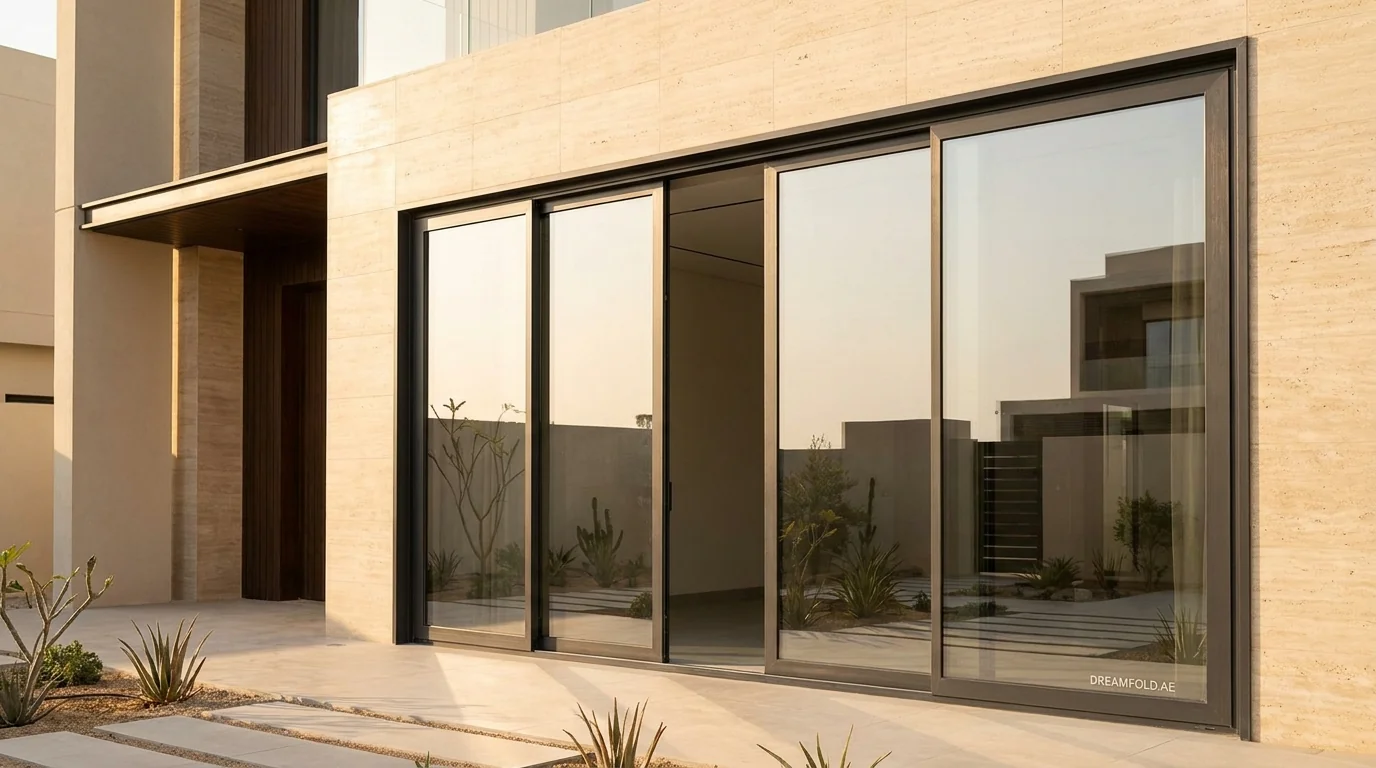
How it is made
The part that makes dual colour possible is the same part that makes a frame perform well in Dubai heat: the thermal break.
Two aluminium shells
A thermally broken profile is not one solid piece of metal. It is an outer shell and an inner shell, which stay physically separate until assembly.
Polyamide bar between them
Insulating polyamide strips join the two shells. They stop heat conducting straight through the frame — and they are also why the two halves can be finished independently.
Each shell coated separately
The outer shell goes through the coating line in one colour, the inner shell in another, each cleaned, pre-treated and cured on its own.
Assembled after coating
The shells are crimped onto the polyamide bars once both finishes are cured, so the colours meet at the break rather than at a visible paint line.
Fabricated to size
The finished profile is then cut, machined and assembled into your door or window, made to the measurements from the site survey.
Beads and caps to match
Glazing beads, trims and cover caps are finished to match whichever side they face, so the detail is consistent all the way round.
Worth knowing: because the colour split happens at the thermal break, dual colour needs to be decided before manufacturing. It is not something that can be added to a frame you already have, and site-painting one face of an existing frame never ages well in UV.
Why people choose it
The facade wins outside
Dark bronze, anthracite or black frames have become the default exterior look on contemporary villas, because they read as a thin line and let the glass dominate.
The interior wins inside
Inside, the same dark frame can feel heavy against pale walls and light floors. A white, cream or wood-effect inner face disappears instead.
Matching existing joinery
Where wardrobes, kitchens and skirtings are already a particular colour, the inner frame can match them rather than fighting them.
Community and developer rules
Many Dubai communities specify the external colour of frames. Dual colour lets you comply outside and still choose freely inside.
Rooms that differ
A villa can have one external colour throughout and different internal colours per zone, since each opening is made individually anyway.
Resale and neutrality
A neutral interior face keeps the room easy to redecorate without the frames dictating the scheme.
Combinations we are asked for most
| Outside | Inside | Where it works |
|---|---|---|
| Matt anthracite grey | Pure or traffic white | The most requested pairing. Contemporary villa outside, bright and neutral inside |
| Jet black | Warm white or off-white | Strong graphic facade, soft interior that does not read as stark |
| Bronze or dark brown | Wood effect | Warm, natural schemes; pairs well with timber floors and joinery |
| Anthracite | Light grey | Where a pure white would look too clinical against concrete or stone interiors |
| Sand or beige | White | Communities with a specified sand-tone external palette |
| Champagne or bronze anodised | White or light grey | Coastal properties, where anodised finishes age particularly well |
| Dark grey | Matt black | All-dark interiors, where the frame is meant to be seen rather than hidden |
Any RAL colour is available on either side. We show physical samples in daylight before anything is ordered, because screens and printed charts both misrepresent colour, and a matt and a satin version of the same RAL can look like different colours on site.
Finish types available
Matt powder coat
Low sheen, the current default for contemporary work. Hides fingerprints and dust better than gloss, which matters in this climate.
Satin and gloss
More reflective finishes, used where a crisper, more traditional look is wanted or to match existing metalwork.
Textured / fine structure
A slight grain in the coating. Excellent at disguising minor marks and the most forgiving finish on a large frame.
Metallic
Coatings with a metallic pigment, giving depth that changes with the light through the day.
Wood effect
A grain pattern applied over the coating, giving a timber appearance on an aluminium frame with no seasonal maintenance.
Anodised
An electro-chemical finish rather than a coating, in natural, bronze and champagne tones. Very durable, and ages gracefully in coastal air.
The two sides do not have to share a finish type either. A textured anthracite outside with a smooth matt white inside is a common and sensible combination, because the outside takes the weather and the inside takes the fingerprints.
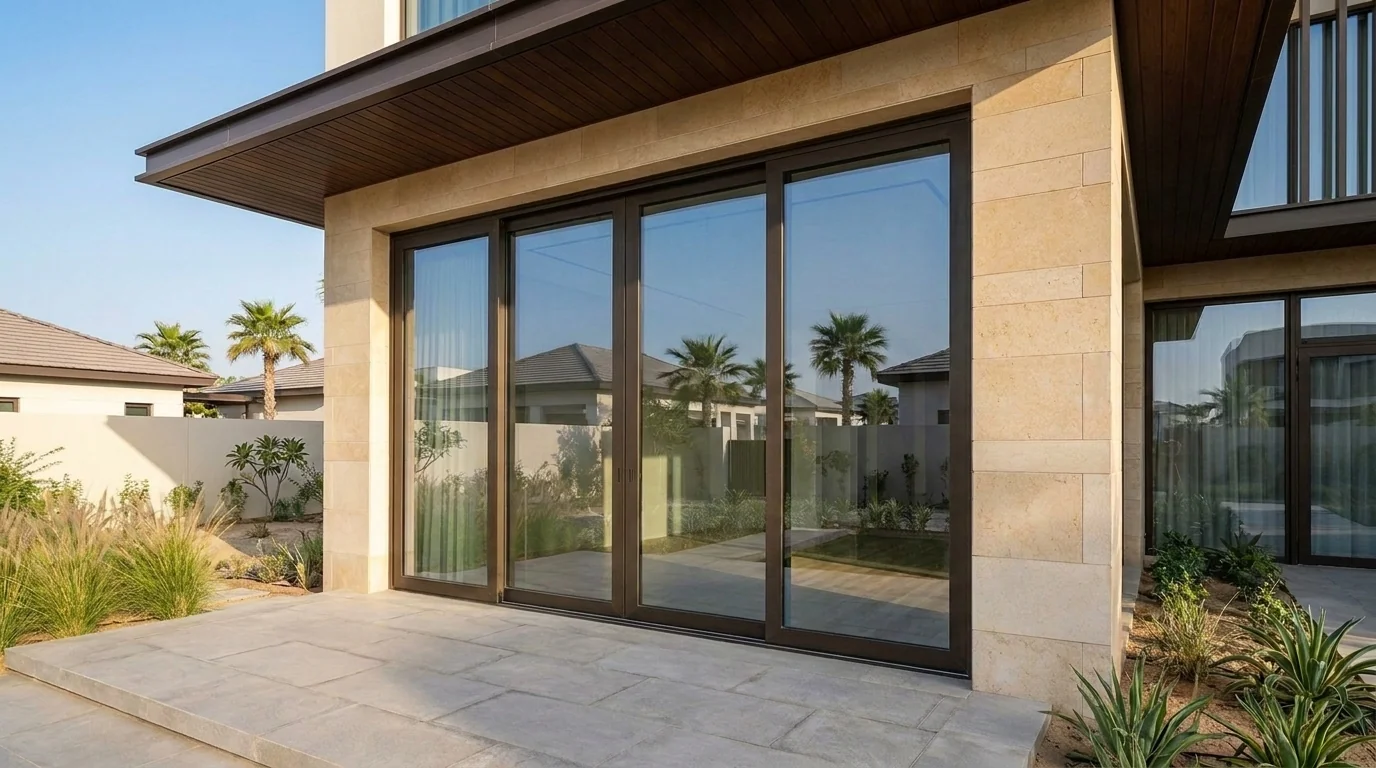
Which products we can supply in dual colour
If it is a thermally broken aluminium system, dual colour is generally available. In practice that covers most of what we make.
- Bifold and folding doors — the most common application, because the frame area is large and very visible from both sides.
- Sliding doors and ultra-slim sliding, where even a slim frame reads strongly against a pale wall.
- Telescopic sliding doors, including the tracks and covers where they are visible.
- Pivot entrance doors, where the outside is the first thing a visitor sees and the inside faces a hallway.
- Villa entrance doorsets and side screens.
- Aluminium windows, usually specified to match the doors on the same elevation.
- Pergolas and shading structures, where the underside can differ from the outer face.
It is not available on PVC systems in the same way, because the construction is different. Where a two-tone look is needed on PVC, foiled finishes are the alternative.
Design considerations before you commit
Dual colour removes a compromise, but it introduces a few decisions that are easy to get wrong on paper and obvious once installed.
- Look at the reveal. The frame is not perfectly flat — there is a depth to it. Decide which colour wraps the reveal, because that face is visible from both inside and out at an angle.
- Think about the opening panel edges. When a bifold folds back, the stack shows the panel edges. Agree at the survey which colour those edges carry.
- Keep handles in one family. Handle and hardware finish should be chosen against the side it is on, but it is worth keeping the same family inside and out so the door does not feel like two different products.
- Match adjacent openings. If only some openings are dual colour, the rest will look like an afterthought. Consistency across an elevation matters more than the individual choice.
- Check the community rules first. Some Dubai developments specify the external frame colour. Confirm before ordering, not after.
- See samples in daylight. Dubai light is harsh and makes mid-greys look lighter than they do indoors. Judge outside, at the property if possible.
How it holds up in the UAE
A coating in Dubai has to survive intense UV, high surface temperatures, salt-laden air near the coast and abrasive dust. That is harder on a finish than almost any European climate.
UV and colour hold
Coatings are specified for high UV exposure so the external colour keeps its depth. Darker colours run hotter in direct sun, which is a reason the thermal break matters, not a reason to avoid them.
Coastal exposure
Near the water, salt is the main enemy of any metal finish. Anodised finishes and high-durability coatings are both used for this, and rinsing with fresh water occasionally does more than any product.
Dust and abrasion
Blown sand scours a finish over years. Textured coatings hide the effect of this far better than gloss.
Repairability
Powder coat can be touched up in situ if a frame is scratched during a later fit-out. It is a repair, not a refinish, and it is far easier on matt and textured finishes.
Cost and lead time
Dual colour costs more than a single finish, and the reason is straightforward: two runs through the coating line instead of one, plus additional handling and stock management.
- Two coating runs. The inner and outer shells are processed separately, which is the main cost.
- Non-standard colours. A common RAL in stock costs less than a special order colour.
- Finish type. Anodised, metallic and wood-effect finishes cost more than plain powder coat.
- Quantity. A whole villa in one pairing is more efficient than one opening in a unique combination.
- Lead time. Dual colour typically adds to the standard 2–3 week aluminium manufacturing window, because of the extra coating stage. Special-order colours add more, and we confirm the date in writing before production starts.
Every project is quoted after a free site visit, with the colour references, finish types and lead time written into the quotation so there is nothing to discover later. For a sense of where prices start on the products themselves, our aluminium bifold doors begin at AED 2,500 per panel and the door buying guide explains what moves that figure.
Looking after a dual colour finish
Wash, do not scour
Warm water, a soft cloth and a mild detergent. Abrasive pads and solvent cleaners damage the coating, and the damage is permanent.
Rinse coastal frames
Near the sea, rinsing salt off the external face every few months does more for the finish than any specialist product.
Keep tracks clear
Sand in a track scratches the coating on the panel edges as the door runs. Vacuuming the track protects the finish as well as the rollers.
Protect during fit-out
Most frame damage happens after installation, during other trades' work. Keep the protective film on until the site is finished.
General care for aluminium doors is covered in the maintenance guide, and we handle repairs through our door services.
Specifying the colours, and where dual colour is used
Dual colour only works cleanly if both faces are specified by reference rather than by description. “Dark grey” is not a colour; a RAL number is.
- Quote both faces by RAL number. The RAL system is the colour standard powder coaters work to — the official reference is RAL Colours. Put the exterior and interior RAL references, and the finish (matt, satin or textured), on the order. Community colour rules are usually written as a RAL number too, so they can be matched exactly rather than approximately.
- Entrance doors are where the inside and outside faces differ most often — see villa entrance doors in Dubai.
- Large glazed openings take the finish across a whole elevation — see aluminium folding doors, sliding doors and ultra-slim sliding doors.
- Interior work where the frame should disappear into the room — see bedroom doors, wardrobe doors and glass partitions.
- Outdoor structures can be matched to the same finish — see pergolas and gazebos in Dubai.
Dual colour aluminium: FAQs
What is dual colour aluminium?
A frame finished in one colour on the outside and a different colour on the inside. It is one frame, not two, with each aluminium shell coated separately before assembly. It is also called two-tone or bicolour aluminium.
How is dual colour possible on one frame?
Thermally broken aluminium profiles are made of two separate shells joined by insulating polyamide bars. Because the shells stay separate until assembly, each can be coated in its own colour and cured before the profile is put together.
Can dual colour be added to frames I already have?
No. The colour split happens at the thermal break during manufacture, so it has to be decided before production. Painting one face of an existing frame on site does not last in UV and tends to fail at the edges.
Which colours can I choose?
Any RAL colour on either side, in matt, satin, gloss, textured, metallic or wood-effect finishes, plus anodised options in natural, bronze and champagne. The two sides do not have to share a finish type.
What are the most popular combinations in Dubai?
Matt anthracite outside with white inside is the most requested. Black outside with warm white inside, bronze outside with a wood effect inside, and sand tones outside with white inside are also common, the last often because a community specifies the external colour.
Does dual colour cost more?
Yes, because the inner and outer shells go through the coating line separately. Special-order colours, anodised, metallic and wood-effect finishes add more. We put the colour references and the cost in the written quotation.
Does it take longer to make?
Yes, a little. Dual colour adds to the standard 2 to 3 week manufacturing window for aluminium systems because of the extra coating stage, and special-order colours add more. We confirm the date in writing before production starts.
Which products can be dual colour?
Thermally broken aluminium systems: bifold and folding doors, sliding and ultra-slim sliding doors, telescopic doors, pivot entrances, villa entrance doorsets, aluminium windows and pergolas. PVC systems use foiled finishes instead.
Will the external colour fade in the Dubai sun?
Coatings are specified for high UV exposure so the colour holds. Dark colours run hotter in direct sun, which is one more reason to use a thermally broken profile, not a reason to avoid dark frames.
Is a dual colour frame harder to maintain?
No. It needs the same care as any coated aluminium frame: warm water, a soft cloth and mild detergent, no abrasives or solvents, and an occasional fresh-water rinse on coastal properties.
Can I see samples before ordering?
Yes, and we recommend it. We bring physical samples to the site visit, because screens and printed charts both misrepresent colour and Dubai daylight makes mid-tones look lighter than they do indoors.
Does my community allow the colour I want?
Some Dubai developments specify the external frame colour. That is exactly where dual colour helps: you comply on the outside and still choose freely on the inside. Check the rules before ordering.
See the colours in person
Tell us the exterior colour your community requires and the interior scheme you are working to, and we will bring samples of both to the site visit. Judging colour in Dubai daylight is the only reliable way to do it.