Do You Need Approval to Change Doors or Glass in Dubai?
Most people assume replacing a door is a weekend job. In Dubai it depends entirely on which door, which community and whether you own the unit. Here is the honest version: what needs a permit, what only needs an NOC, what needs nothing at all, and who signs off.
The 30-second answer
What actually needs approval, and what doesn’t
The dividing line in Dubai is not the price of the job or how long it takes. It is whether you are touching the structure, the external appearance, the fire strategy or common property. Change any of those and you are in permit territory. Stay inside your own four walls with the same opening size and you usually are not.
Usually no permit needed
- Swapping an internal door for another internal door in the same opening
- Replacing a shower screen or frameless shower glass inside an existing wet area
- Fitting wardrobe doors or internal folding doors that divide a room without a new wall
- Replacing glass in an existing frame, same size, same performance class
- Re-finishing or re-spraying an existing door leaf
Expect to need approval
- Making an existing external opening wider, taller or a different shape
- Cutting a brand-new opening in any wall — internal or external
- Anything that changes the look of the facade from outside
- Replacing or removing a fire-rated door or anything on an escape route
- Glass partitions in an office — any partition triggers a full fit-out permit
- Work that touches a shared wall, lobby, corridor or building entrance
The trap most people fall into: “It is only a door, nobody will notice.” On a villa facade someone always notices — usually the community inspector, often after the frame is already in. Reinstating an unapproved opening costs several times what the approval would have cost, and the fine sits on top.
- Who actually approves your job
- Villas: what crosses the line
- Apartments: the NOC chain
- Offices and retail: fit-out permits
- The technical specs you will be judged on
- Documents to have ready
- Realistic timelines
- Owner vs tenant
- Frequently asked questions
Step one
Who actually approves your job
This is where most online advice goes wrong. People assume Dubai Municipality approves everything. It does not. Dubai has several permitting authorities, and which one governs you is decided by your plot, not by your postcode or the name of your neighbourhood.
| Authority | Broadly covers | What it means for a door or glass job |
|---|---|---|
| Dubai Municipality (DM) | Most mainland plots — villas, commercial buildings, the majority of modifications | Building permit or modification permit through the Dubai BPS portal |
| Trakhees (PCFC) | Ports, Jebel Ali and Palm jurisdictions, plus industrial and free-zone plots | Separate permit track and its own EHS requirements |
| DDA | Business Bay, Downtown, DAMAC communities, Sports City, Motor City, Dubailand, Wasl and others | Own fit-out and modification approvals |
| Master developer | Emaar, Nakheel, DAMAC, Dubai Properties and similar | Community NOC, often required before the authority will look at you |
| Owners Association / building management | Any apartment building or managed community | Building NOC, access permissions, working hours, lift protection |
| Dubai Civil Defence | Fire strategy, escape routes, fire-rated assemblies | Involved whenever fire doors or exit routes are affected |
The one thing worth remembering: in several parts of Dubai, DM and DDA jurisdiction is mixed plot by plot. The governing authority should be confirmed from your affection plan, not assumed from the area name. If a contractor tells you which authority applies without having seen your affection plan, they are guessing.
In practice the sequence is almost always the same: owner consent → community or building NOC → authority permit → work → inspection. Skipping the middle step is the single most common reason a job gets stopped halfway, with the old doors already removed and the opening sitting open.
Villas
Villas: what crosses the line
Villa owners get the most freedom in Dubai and also the most expensive mistakes. Inside the villa you can do a great deal without a permit. The moment you touch the envelope — the external walls, the roof line, the facade — you are in a different process.
Work that normally proceeds without a building permit
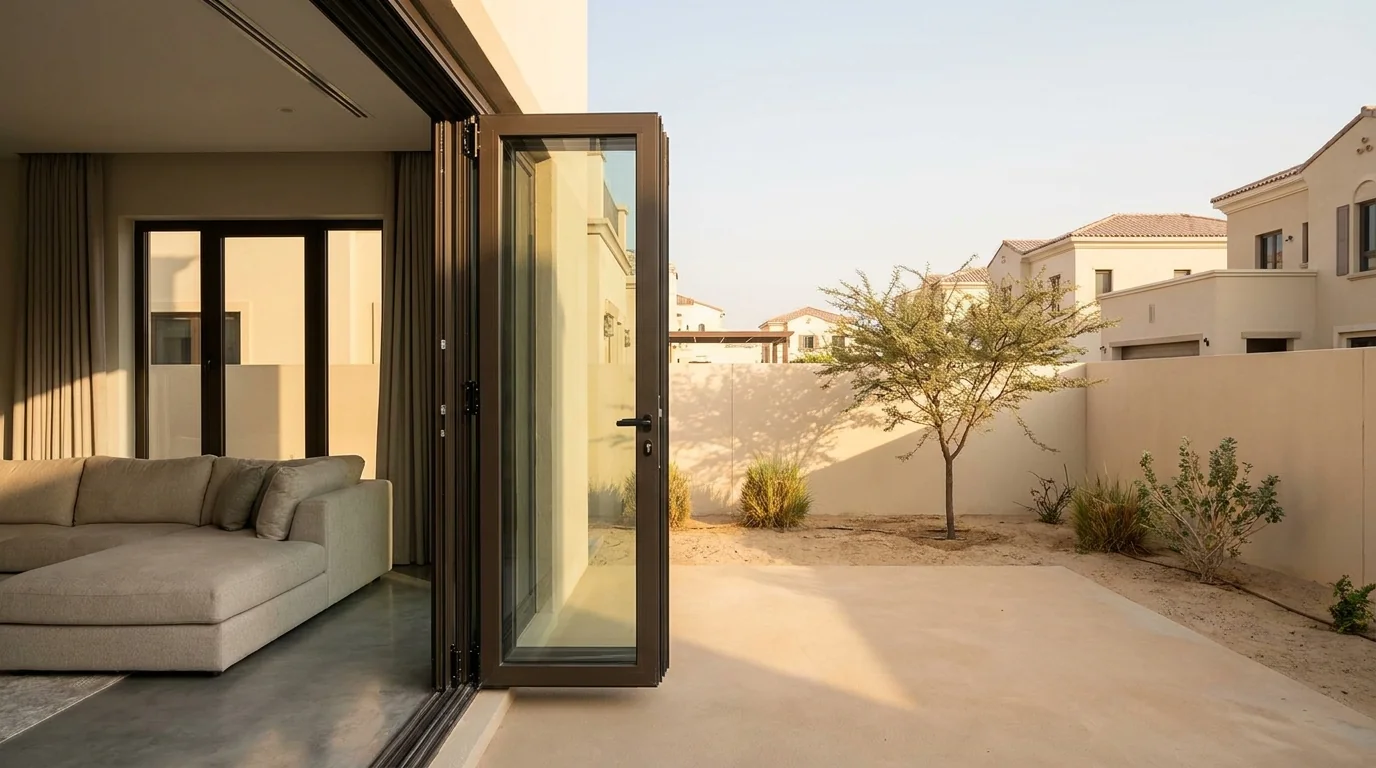
Changing internal doors room to room, fitting internal folding doors between a living and dining area, replacing wardrobe fronts, upgrading a shower enclosure, or replacing an existing external door with a new one of the same size in the same opening. You are not altering the structure, the opening or the elevation.
Work that triggers a permit almost every time
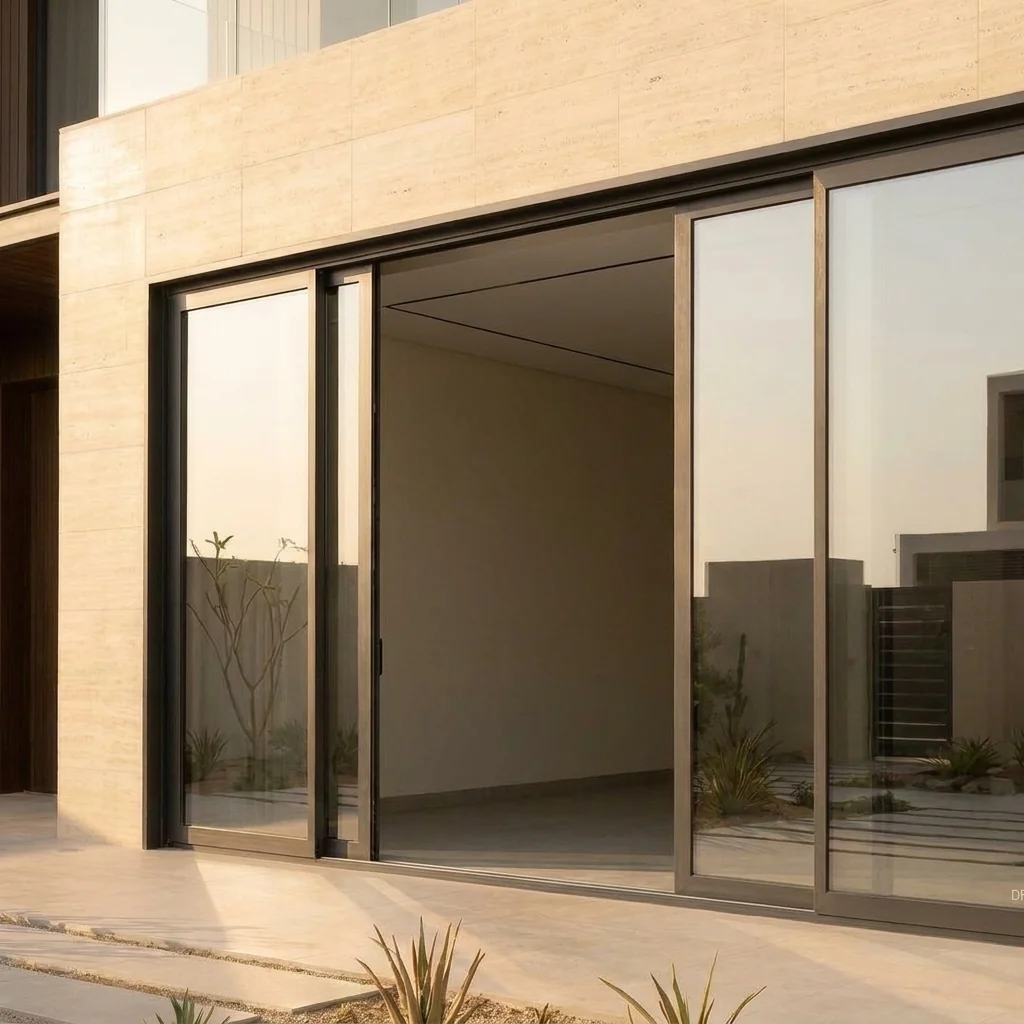
- Widening an opening. The classic case: a 2.4 m patio door becoming a 4 m or 6 m sliding door. That means cutting blockwork and installing a new lintel. Structural, therefore permitted.
- Creating a new opening. Turning a window into a door onto the garden, or opening a wall onto a new terrace.
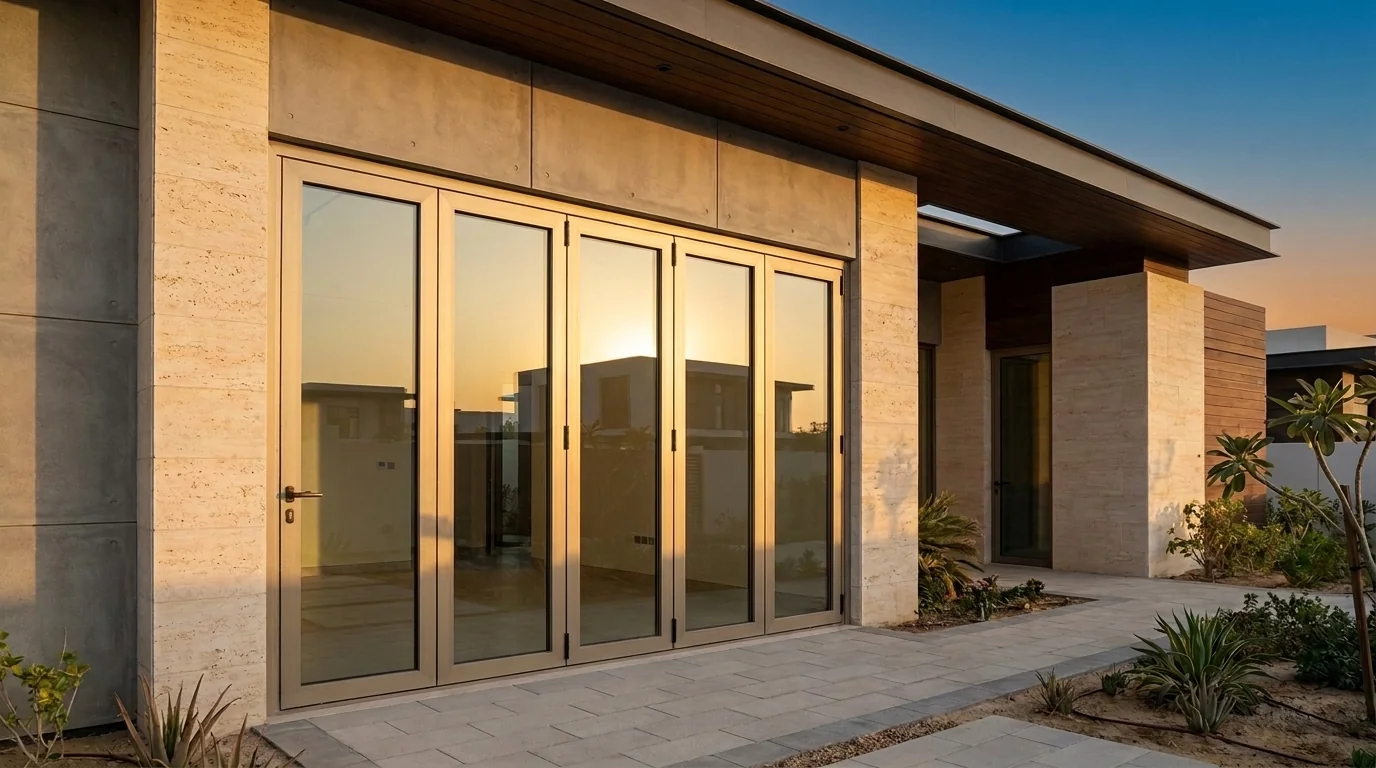
- Changing the facade. New frame colour, different proportions, a glazed box where solid wall used to be. Many communities have an approved exterior palette and will hold you to it.
- Extensions and covered areas. A new pergola or gazebo attached to the villa is a built addition, not furniture.
- Boundary wall changes. New gates and screens are usually governed by community rules even when DM is relaxed about them.
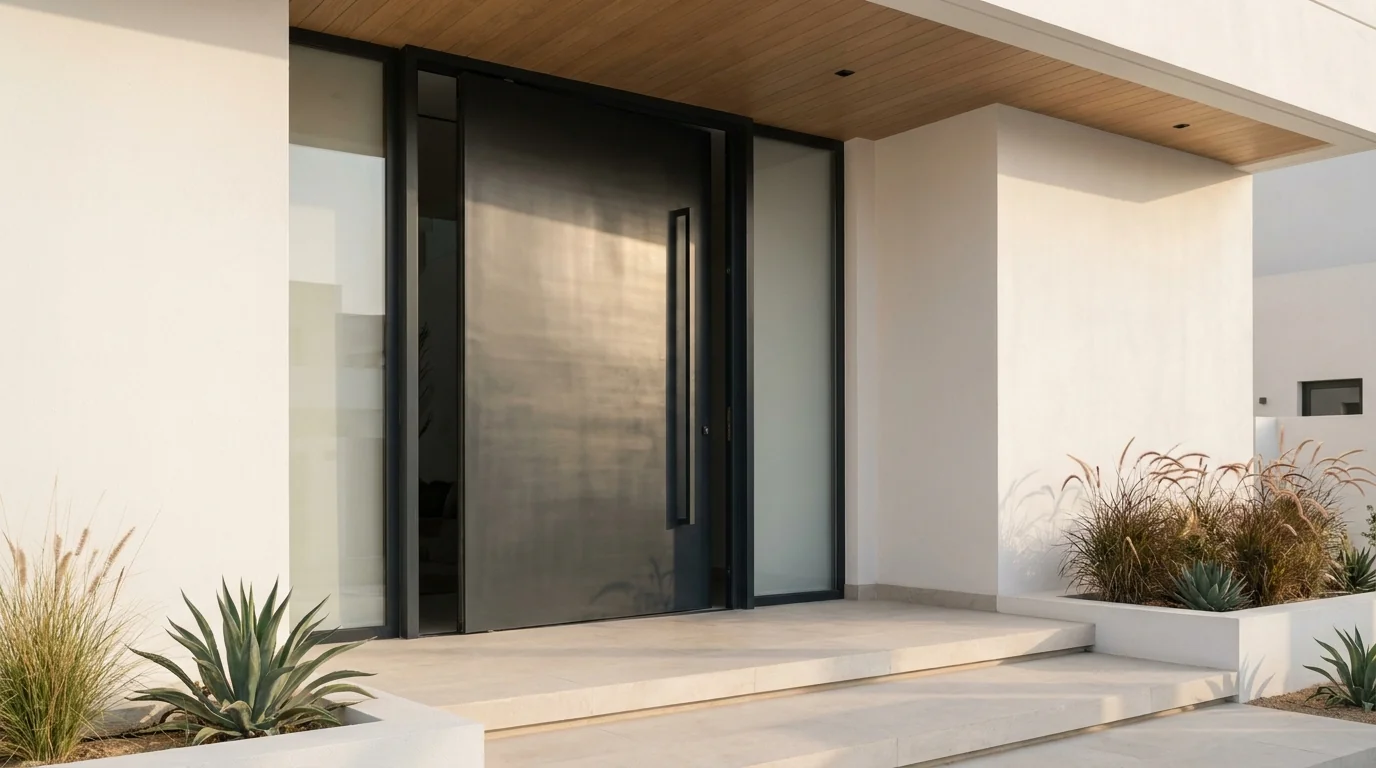
For an oversized pivot entrance door the question is nearly always the opening. If your existing entrance is 1.2 m wide and you want a 1.6 m pivot leaf, the opening has to change — and that is a permitted alteration, plus a community design review in most Emaar and Nakheel communities.
Send us a photo of the opening and tell us your community. We will tell you straight whether it needs approval — before you commit to anything.
Apartments
Apartments: the NOC chain nobody warns you about
In an apartment you own the inside of your unit. You do not own the facade, the balcony balustrade, the corridor or the building entrance — those are common property, and that single fact decides most of what you can and cannot do.
What usually goes ahead
- Internal door replacement, same opening
- Shower enclosure and bathroom door upgrades
- Wardrobe and storage doors
- Internal glass screens that do not form a new room
Still expect to file a works notification with building management and agree working hours.
What needs the building’s blessing
- Anything visible from outside, including balcony glazing
- Replacing balcony sliding doors with a different frame or colour
- New internal partitions that change the unit layout
- Work affecting the entrance door — it is usually fire-rated
Your Owners Association and the master developer may both need to sign.
What is normally refused
- Enclosing or glazing in an open balcony
- Changing the external frame colour to something off-palette
- Removing or downgrading the fire-rated entrance door
- Anything that alters the building’s uniform elevation
Buildings enforce these hard because the whole elevation has to stay consistent.
Your apartment entrance door is almost certainly a fire door. It is part of the building’s fire compartmentation, not a decorative item. Replacing it with a non-rated door is a life-safety breach, will fail inspection, and can affect the building’s insurance. If you want a better-looking entrance, the answer is a certified fire-rated door with the finish you want — not an unrated one.
Offices & retail
Offices and retail: it is a fit-out permit, not a decor permit
Commercial work is where the rules bite hardest, and where the most money gets wasted on rework. The critical detail: a decor-level permit generally covers cosmetic finishes only. The moment a partition appears — of any material, including glass — you are in full fit-out territory.
Published guidance on the Dubai Municipality self-decor route is explicit that any partition wall that divides or alters a space requires a full fit-out permit, and that the self-decor track does not apply to villas or apartments at all. So if you are planning glass partitions for meeting rooms, assume a fit-out permit from day one and plan the programme around it.
Triggers a full fit-out permit
- Any new partition — gypsum, glass, timber or demountable
- Relocating MEP: sockets, lighting, sprinklers, AC grilles
- Ceiling changes that move services
- Creating or moving a wet area
- Change of use for the premises
Pulls in Civil Defence
- Any change to escape routes or travel distances
- Fire-rated door replacement or relocation
- Partitions that affect sprinkler or detector coverage
- Smoke compartmentation changes
- Door hardware on exit doors
Easy to get wrong
- Glass partitions blocking a sprinkler head
- A meeting room with no second means of escape
- Doors opening against the direction of escape
- Locking hardware on a designated exit
- Partitions fixed to a ceiling that cannot carry them

If you are fitting out a hotel, clinic, showroom or office, the same logic applies to every commercial door on the floor plate. We cover the practical side of specification — traffic ratings, closers, access control, acoustic performance — on the commercial doors page.
Technical
The specifications your approval will actually be judged on
An approval is not a formality where someone glances at a drawing. If your job goes down the permit route, the glass and the frame get assessed against real performance numbers. These are the four that matter for doors and glazing in Dubai.
1. Thermal performance of the glazing
Dubai’s green building system, Al Sa’fat, sets envelope requirements for permit-track work. In current practice that means glazing U-values in the region of 1.9–2.0 W/m²K and a solar heat gain coefficient around 0.28 where the glazed area is 40–60% of the wall. The SHGC ceiling is banded by how much of your wall is glass, which is exactly why “just make the whole wall glass” is harder to approve than people expect. Private villas have some flexibility on certain requirements, so the position needs confirming for your specific plot rather than assumed.
The practical consequence: single glazing will not pass on a permitted external opening. You need a thermally broken frame and a proper insulated glass unit — which is what a thermally broken slim sliding system is engineered to deliver.
2. Safety glass in the right places
Glass in and beside doors is impact-risk glazing. It should be toughened or laminated safety glass, correctly marked. This is not a Dubai quirk — it is standard practice worldwide — but it is checked here, and an unmarked pane is an easy inspection failure.
3. Fire rating where the fire strategy needs it
Apartment entrance doors, stair doors, corridor doors, service risers and most commercial cross-corridor doors carry a rating. A rated assembly is certified as a whole — leaf, frame, seals, hinges and closer together. Swapping the leaf alone voids it. The UAE Fire and Life Safety Code governs this.
4. Wind load and structural fixing
A 6 m sliding door on an exposed villa elevation sees serious wind pressure. Approvals on larger openings look at the structural fixing and the lintel. This is why a widened opening is a structural job with a drawing, not a carpentry job.
Why this matters commercially: the specification that passes approval is also the specification that performs. Thermally broken frames and proper IGUs are the difference between a room you can use at 3 pm in August and one you cannot. The regulation is pushing you towards the system you actually want.
Paperwork
Documents to have ready
Approvals stall on missing paperwork far more often than on design objections. Collecting this set before you apply typically removes a week or two from the process.
Proof of ownership
Title deed for the unit or villa. Tenants need this from the owner along with a written NOC.
Affection plan
Confirms the plot and — critically — which authority governs it. Do not skip this.
Existing drawings
Stamped as-built floor plans and elevations showing the opening as it is today.
Proposed drawings
CAD plans, elevations and sections with dimensions, materials and finishes marked.
NOCs
Landlord or owner, Owners Association or building management, and master developer where applicable.
Contractor credentials
Trade licence and insurance of the company doing the work. Communities check this.
Product data
System datasheets, glass specification, thermal values and fire certificates where relevant.
Method statement
How the work will be done, protection of common areas, working hours, waste removal.
Drawings, product data, thermal and fire documentation, and the NOC paperwork for your community — handled by us, not handed to you as a to-do list.
Timing
How long it realistically takes
Fabrication is rarely the bottleneck. Approvals are. These are working ranges we plan projects around — treat them as planning figures, not guarantees, because every community and authority runs at its own pace.
| Type of work | Approval route | Typical approval time | Plan for |
|---|---|---|---|
| Internal door swap, same opening | None, or a works notification | 0–3 days | Survey to install in 2–4 weeks |
| Shower or wardrobe glass | Building notification | 0–3 days | 2–3 weeks |
| Apartment balcony door replacement | OA + developer NOC | 1–3 weeks | 4–7 weeks total |
| Villa opening widened for a sliding or folding door | Community NOC + authority permit | 3–8 weeks | 8–14 weeks total |
| Office glass partitions | Fit-out permit (+ Civil Defence if escape affected) | 2–6 weeks | 6–12 weeks total |
| Fire-rated door replacement | Civil Defence involvement | 2–6 weeks | 6–10 weeks total |
What actually causes the delays
- Applying to the wrong authority. Comes straight back, and you start again. This is the affection plan point.
- Missing NOCs. Authorities will not process without the community sign-off in the pack.
- Drawings that do not match reality. As-builts in Dubai are frequently out of date. Measure, do not trust the file.
- Specification gaps. No thermal data, no glass certificates, no fire certification for a rated opening.
- Summer slowdowns. Midday working restrictions apply across the UAE in peak summer and affect site programmes.
Plan your order around the approval, not the other way round. We hold fabrication until approval is in hand on permit-track jobs. A fabricated 6 m sliding unit sitting in a warehouse because the community rejected the frame colour is an expensive way to learn this.
Cost
What approvals cost, and what skipping them costs
Approval fees are a small line in a door project. The real financial risk is the rework, which is why this is worth getting right rather than fast.
The approval itself
Authority fees for straightforward modification and decor-level permits are modest — often a few hundred dirhams in authority fees. Where it adds up is the consultant drawings and submission handling, commonly quoted in the low thousands for a residential job.
Getting it wrong
Published guidance on unpermitted commercial works points to fines starting around AED 5,000 with daily continuation penalties, and regularising after the fact costing several times the original permit. Residential communities also levy their own penalties and can demand reinstatement.
The hidden cost
Being told to reinstate. Removing a fitted system, rebuilding the opening, making good the facade and starting again dwarfs every other number on this page — and you still have to get the approval afterwards.
Fees, fines and processes change. Confirm current figures with your governing authority or community before you budget — and treat any contractor quoting fines to the dirham from memory with caution.
How this affects what you should buy
If your job is permit-track anyway, the marginal cost of specifying properly is small and the benefit is large. You are already paying for drawings, submission and inspection. Putting a thermally broken system with a compliant IGU into that opening costs more than a cheap single-glazed frame, but it is the version that passes, performs in August, and does not come back as a warranty problem. Our door buying guide covers how to compare systems on more than price.
Owner vs tenant
Renting? Read this first
Tenants in Dubai can change far more than they think, provided the sequence is right and the change is reversible. The mistake is starting work and asking afterwards.
If you rent
- Written owner NOC first — every single time, even for internal work
- Agree in writing whether you reinstate at the end of the tenancy
- Reversible, non-structural changes are far easier to get agreed
- Never touch the entrance door, balcony glazing or anything external
- Keep the old doors — you may need to put them back
If you own and rent out
- Give consent in writing with the scope defined, not verbally
- Require the contractor’s trade licence and insurance
- State clearly who holds the warranty afterwards
- Be aware unapproved work by a tenant lands on your title, not theirs
- Specify reinstatement conditions up front
Short-let and holiday-home operators sit in a stricter category again, because the unit is being used commercially. Expect the building to apply fit-out rules rather than residential ones.
How we work
Where DreamFold fits into this
We install doors and glass across Dubai and the UAE, which means we deal with these approvals constantly — Emaar and Nakheel communities, DDA buildings, Trakhees plots and mainland DM villas.
We tell you early
At survey stage we confirm whether your job is permit-track or not, and what the community is likely to say. You get that before you commit money, not after.
We prepare the pack
Shop drawings, elevations, system datasheets, thermal and glass specification, and fire certification where the opening needs it — in the format authorities expect.
We sequence the work
Fabrication is held until approval is confirmed on permit-track jobs, so nothing is cut to the wrong size and no opening is left open waiting for a decision.
You can see completed projects across villas, apartments and commercial fit-outs on our work page, and the installation process itself is set out on the door installation page.
FAQ
Frequently asked questions
Do I need a permit to replace an internal door in Dubai?
Normally no. Replacing an internal door with another internal door in the same opening is not a structural or external change, so it does not usually require a building permit. If you live in an apartment, tell building management before the work so access and working hours are agreed. Tenants still need the owner’s written NOC.
Do I need approval to replace a sliding door onto my villa garden?
If the new door goes into the existing opening at the same size, usually you need the community NOC rather than a full permit. If the opening is being widened, a new lintel is involved and that is a structural alteration requiring an authority permit as well as community design approval.
Who approves work in my community — Dubai Municipality, Trakhees or DDA?
It depends on the plot. Dubai Municipality covers most mainland plots. Trakhees covers Ports, Jebel Ali and Palm jurisdictions plus free-zone and industrial plots. DDA covers areas including Business Bay, Downtown, DAMAC communities, Sports City, Motor City, Dubailand and Wasl. In some areas jurisdiction is mixed plot by plot, so it should be confirmed from your affection plan rather than assumed from the area name.
Can I change my apartment’s front door?
Only to another certified fire-rated door of equivalent or better rating, with building management approval. Apartment entrance doors form part of the building’s fire compartmentation. Fitting an unrated door is a life-safety breach that will fail inspection and can affect the building’s insurance.
Do glass partitions in an office need a permit?
Yes. Published guidance on the Dubai Municipality self-decor route is explicit that any partition wall — gypsum, glass, timber or demountable — that divides or alters a space requires a full fit-out permit rather than a decor-level permit. Civil Defence also becomes involved if escape routes, sprinkler coverage or detection are affected.
Can I enclose or glaze my apartment balcony?
In most Dubai buildings, no. The balcony forms part of the building’s external elevation and is common property, so enclosing it changes the facade and is normally refused by the Owners Association and the master developer. A few buildings permit a specific approved system — check before you plan anything.
What happens if I do the work without approval?
Published guidance points to fines starting around AED 5,000 for unpermitted commercial works, with daily continuation penalties, and regularising afterwards costing several times the original permit fee. Communities can also require reinstatement at your cost. The reinstatement is usually the expensive part, not the fine.
I am a tenant. What can I change without the landlord?
Nothing structural, nothing external, and realistically nothing at all without written consent. Even reversible internal work should have the owner’s NOC in writing, stating the scope and whether you must reinstate at the end of the tenancy. Keep the original doors.
Does new glazing have to meet a thermal standard?
On permit-track work, yes. Dubai’s Al Sa’fat green building system sets envelope requirements, with glazing U-values in the region of 1.9–2.0 W/m²K and a solar heat gain coefficient around 0.28 where glazing is 40–60% of the wall area. The SHGC limit is banded by glazed area. Private villas have flexibility on certain requirements, so confirm the position for your plot.
How long does approval take for a door project?
A straightforward internal replacement needs little or nothing and can be done in weeks. An apartment balcony door typically needs one to three weeks of NOCs. A widened villa opening commonly runs three to eight weeks of approvals before fabrication starts, and an office fit-out two to six weeks, longer if Civil Defence is involved.
Related reading
Next steps by project type
Villas
Wide openings onto gardens and pools: sliding doors, folding doors and telescopic systems. Entrances: pivot doors.
Apartments
Interior-led work that stays inside your unit: internal bifold doors, wardrobes and shower glass.
Offices & retail
Glass partitions, commercial doors, fire-rated doors and switchable privacy glass.
Official sources worth bookmarking: Dubai Municipality, Trakhees, Dubai Development Authority and Dubai Civil Defence. This guide is general information, not a substitute for confirmation from the authority governing your plot.
Tell us the opening. We will tell you the rules.
Free site survey across Dubai and the UAE. We confirm whether your job needs approval, prepare the drawings and documentation, and only fabricate once you are cleared to proceed.