
Tempered vs Laminated Glass in Dubai: Which One Does Your Door Actually Need?
Almost every door quote in Dubai says "toughened glass" and stops there. That single line hides four separate decisions — safety, glazing build-up, coating and thickness — and getting any of them wrong costs you either money, comfort or a replacement panel. Here is how a fabricator actually chooses.
About four times stronger than annealed, and it breaks into blunt granules
Breaks but stays in the frame, held by its interlayer
Two panes and a sealed cavity — this is what cuts heat
The invisible coating doing most of the work in Dubai sun
The short answer, if you only read one section
Tempered and laminated are not competing products. They solve different problems, and in Dubai a surprising number of jobs need both.
Tempered glass is the right default for most door leaves. It is strong, it resists the thermal stress of a west-facing elevation, and when it does break it falls as small blunt granules rather than blades. That is why it sits in nearly every aluminium bifold door and sliding door we make.
Laminated glass is the right answer when the glass must stay in the opening after it breaks. Overhead glazing, balustrades, anything above a walkway, anything at height, anything where a falling pane would hit a person. It also blocks nearly all UV and performs better acoustically than a single pane of the same thickness.
Laminated-tempered — two tempered panes bonded by an interlayer — is what you specify when you need both the strength and the retention. It costs more. Sometimes there is no alternative.
And none of those three choices say anything about heat. Heat is controlled by whether the unit is single or double glazed and whether it carries a low-emissivity coating. A single pane of 10 mm toughened glass is strong, compliant and still a poor thermal performer. That distinction is where most Dubai buyers lose money.
What this guide covers
- The four decisions behind every glass spec
- Annealed glass and why it rarely belongs in a door
- Tempered glass: strength, breakage and its one real weakness
- Laminated glass and what the interlayer actually does
- Single vs double glazing in a Dubai door
- Low-E coatings and which surface they belong on
- What Dubai's regulations require
- Glass thickness by application
- How to read the glass line on a quote
- What this means for each door type
- Frequently asked questions
Every glass spec is four decisions, not one product
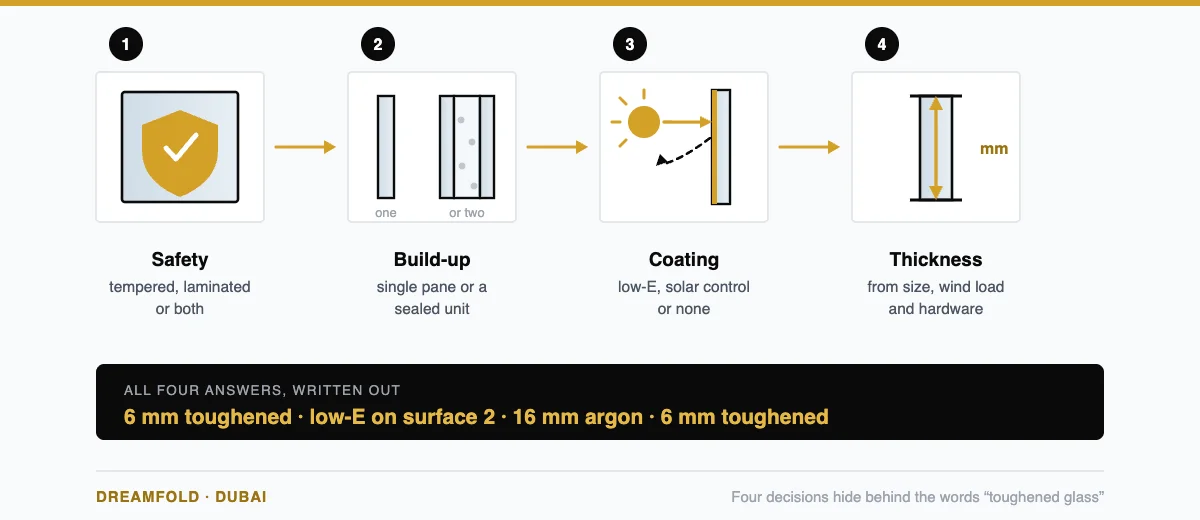
When a supplier writes "8 mm toughened" on a quote, they have answered one and a half of the following four questions. Ask for all four and you will immediately be able to compare two quotes properly.
 Tap to enlarge
1. Does it have to be safety glass?
Safety glass means tempered, laminated, or both. In a door the answer is effectively always yes — doors are impact locations by definition. The real question is which kind of safety glass, and that depends on what happens if the pane fails.
2. Single pane, or a sealed double-glazed unit?
This is the heat and noise decision. It is also the cost decision: a double-glazed unit roughly doubles the glass content and needs a deeper frame to hold it. Many slim systems cannot take one at all.
3. Which coating, and on which surface?
Low-E, solar control, or neither. In Dubai this is not optional on a large south or west elevation. The surface it sits on changes the result.
4. How thick?
Driven by pane size, wind load, edge support and the hardware. Not by preference, and not by whichever number the last client chose.
Those four answers, written out, look like this: 6 mm toughened / 16 mm argon / 6 mm toughened low-E on surface 2. If your quote does not contain something of that shape, you do not yet know what you are buying.
Annealed glass: the baseline nobody should put in a door
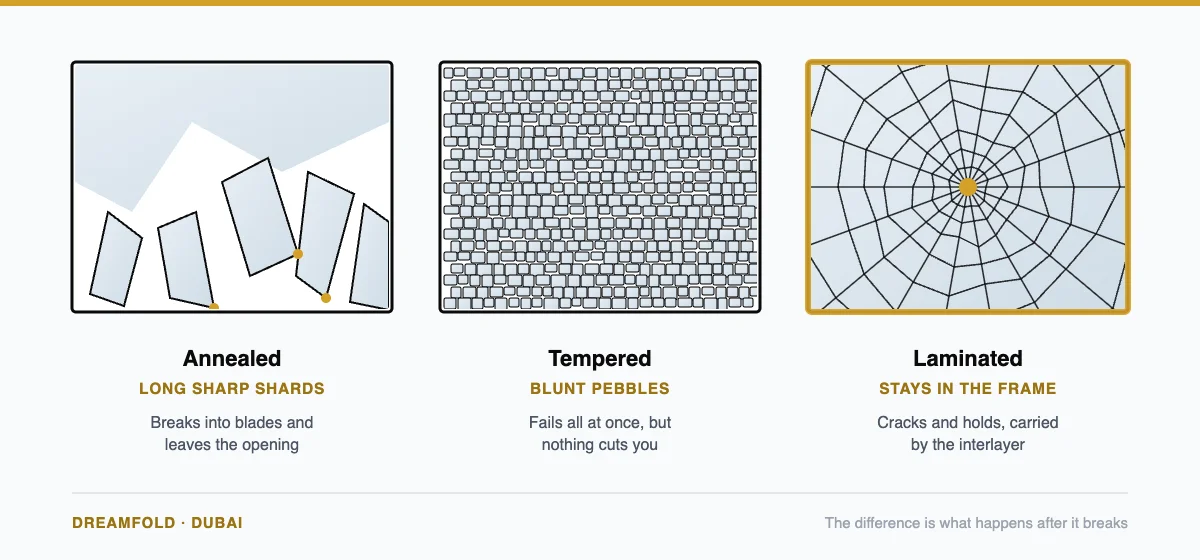
Annealed is ordinary float glass, cooled slowly, with no surface stress built into it. It can be cut, drilled and edge-worked on site, which is exactly why it still turns up in cheap work. It is also the only one of these products that breaks into long, sharp shards.
Annealed glass has a legitimate place — picture framing, cabinet fronts, internal screens that cannot be walked into. It does not belong in a door leaf, a shower, a balustrade or anything within reach of a person moving at speed. If a quote for an entrance or a glass partition does not say toughened or laminated anywhere, assume annealed and ask.
 Tap to enlarge
A Dubai-specific reason to care: thermal stress. When part of a pane sits in direct sun and part sits in the shadow of a reveal or a mullion, the two zones expand by different amounts. Annealed glass has no reserve of surface compression to absorb that, and edge damage from cutting becomes a crack origin. Tempered glass handles the same condition without complaint.
Tempered glass: what "toughened" actually buys you
Tempered and toughened are the same thing. Two words, one product, and the word you see on a Dubai quote depends on whether the supplier learned the trade from an American or a British specification.
How tempering works
The cut and edge-worked pane goes through a furnace and is heated well past its glass transition temperature — roughly 620 °C — then hit with forced air that chills the surfaces far faster than the core. The outer faces lock into compression while the centre stays in tension. That locked-in compression is the whole product. Glass fails in tension, so a surface that has to be pulled out of compression before it can be put into tension is simply much harder to break.
How strong, in numbers
Under ASTM C1048, a fully tempered 6 mm pane must reach either a minimum surface compression of 69 MPa (10,000 psi) or an edge compression of at least 67 MPa. Glass sold specifically as safety glazing is generally taken past 100 MPa. In practical terms tempered glass is around four times stronger than annealed glass of the same thickness.
Note what that does and does not mean. Four times stronger is a comparison against a weak baseline, not a guarantee. A 6 mm tempered pane in a 2.4 metre door leaf is still a 6 mm pane, and it will still deflect visibly in a gust. Strength class does not replace correct thickness.
How it breaks, and why that is the point
When tempered glass fails, the stored energy releases all at once and the entire pane disintegrates into small, roughly cubic granules. It is loud, it is total, and it is survivable. Compare that with the long blades annealed glass produces and the reason every code in the world calls it safety glass becomes obvious.
The flip side is that the failure is total. There is no cracked-but-intact stage. A tempered door leaf that breaks is an open hole in your villa until a replacement is cut, and in Dubai that is typically a wait, not an afternoon — which is the single best argument for keeping the original glass spec on file. Our glass door repair team asks for it first every time.
The one real weakness: nickel sulfide
Tempered glass can fail years after installation with no impact at all. The usual cause is a microscopic nickel sulfide inclusion in the glass, most often traced back to stainless steel contamination during manufacture or handling. The inclusion slowly changes volume inside the tensile core until it cracks the pane from the inside. The signature is unmistakable: a figure-eight break pattern with two loops roughly 30 mm across at the origin.
It is rare. It is also the reason that, for overhead glazing and anything where a spontaneous failure would be dangerous, specifiers ask for heat-soak-tested glass — panes held at elevated temperature after tempering so that suspect inclusions fail in the factory rather than above a dining table. Ask for it on skylights and overhead glazing. You will not need it on a ground-floor bedroom door.
Everything happens before the furnace
Tempered glass cannot be cut, drilled, notched or edge-ground afterwards. Any attempt shatters it. Every hole for a patch fitting, every cut-out for a lock, every polished edge has to be finished before tempering. This is why re-measuring a shower or a pivot entrance door after the glass is ordered is an expensive conversation, and why good fabricators are slow to accept site dimensions they have not checked themselves.
Laminated glass: the pane that stays where you put it
Laminated glass is two or more panes bonded to a polymer interlayer under heat and pressure. The glass still breaks. The difference is that the fragments stay stuck to the interlayer, so the pane holds its shape and stays in the opening — the familiar spider-web crack pattern with everything still in place.
What the interlayer does
A common residential build-up is 2.5 mm glass, a 0.38 mm interlayer and another 2.5 mm glass — which is why you will see laminated glass quoted as 5.38 mm rather than a round number. Thicker and stiffer interlayers are used where the broken pane has to carry load rather than just hang together.
PVB, EVA and ionoplast, briefly
PVB
The industry default. Proven, economical and widely available in Dubai. For noise reduction it needs a specific acoustic grade — standard PVB is not an acoustic product.
EVA
A cross-linked, thermoset interlayer. More moisture tolerant at exposed edges, which matters in wet areas, and it handles sound without a special compound.
Ionoplast
Much stiffer. Specified where the broken pane still has to behave structurally — balustrades, fins, long unsupported spans. Priced accordingly.
Where laminated genuinely beats tempered
- Anything overhead. A tempered pane that fails above head height empties itself onto whatever is below. A laminated pane sags and holds.
- Balustrades and anything at height. Retention is the requirement, not strength.
- UV control. An adequate PVB, EVA or TPU interlayer blocks very nearly all ultraviolet, which is the practical difference between furniture and rugs that fade in three Dubai summers and ones that do not.
- Noise. Laminated glass attenuates sound noticeably better than a single pane of the same total thickness, and combining unequal glass thicknesses either side of the interlayer works better again. On a Sheikh Zayed Road-facing apartment this is the single most effective glass decision available.
- Security. Breaking it does not open it. That is a different property from strength, and it is the one burglars care about.
When you need both: laminated-tempered
Two tempered panes bonded with an interlayer. You get the surface compression and thermal-stress tolerance of tempering plus the post-breakage retention of lamination. This is what belongs in a frameless glass roof, a pool-facing balustrade, or large telescopic sliding doors where a panel is both enormous and in a public area. It is the most expensive option on this page and it is occasionally the only correct one.
Not sure whether you need tempered, laminated or both?
Send us a photo of the opening and tell us where it is — ground floor, overhead, balustrade, wet area. We will tell you which one the job actually needs and why.
Single vs double glazing in a Dubai door
Here is the part that most quotes skate over, and the part that decides what your AC bill looks like in July. Tempered and laminated are safety decisions. Single versus double glazed is the performance decision, and they are completely independent of each other.
 Tap to enlarge
What is actually inside a sealed unit
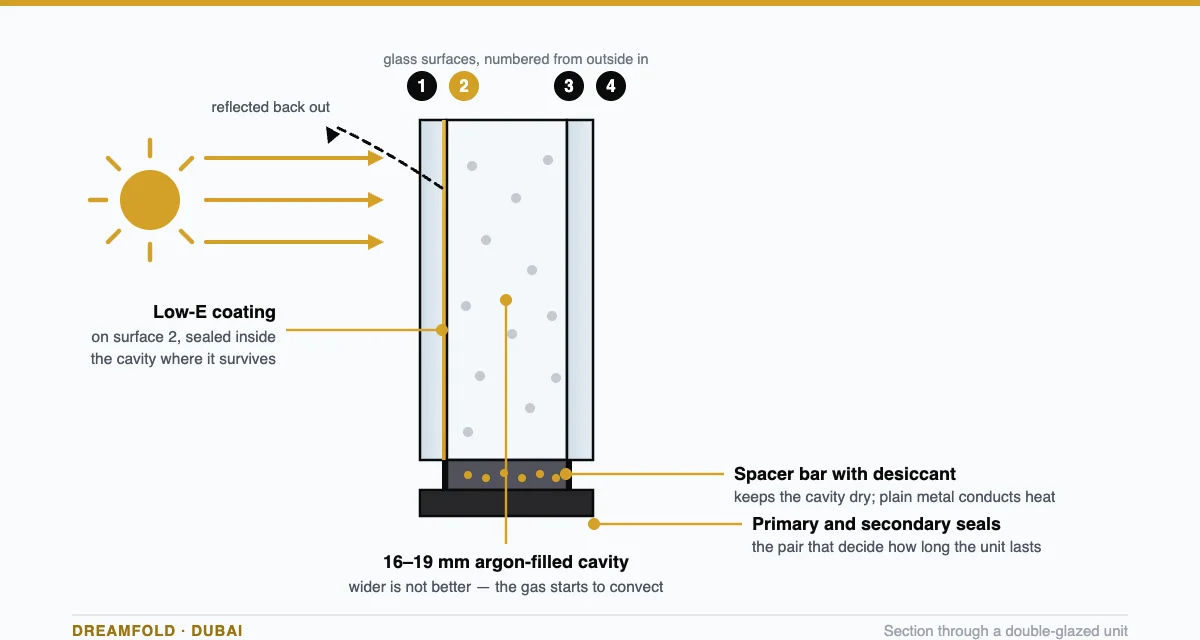
A double-glazed unit — properly an insulated glazing unit, or IGU — is two panes separated by a spacer bar, with the cavity sealed and usually gas-filled. The spacer holds desiccant that keeps the cavity dry. Two seals do the work: a primary seal against moisture vapour and a secondary seal that holds the sandwich together structurally. Glass in IGUs typically runs from 3 mm to 10 mm per leaf.
Cavity width and gas fill
Most sealed units reach their best insulating value with a cavity somewhere around 16 mm to 19 mm. Narrower and conduction across the gap rises; wider and the gas starts convecting inside the cavity, which undoes the benefit. This is a genuine optimum, not a more-is-better scale.
Argon is the standard fill because its thermal conductivity is about 67% that of air — a straightforward gain for very little money. Krypton is roughly half the conductivity of argon again and tolerates a narrower gap, which is why it appears in very slim units and high-performance triple glazing. It is also expensive enough that for a Dubai villa it is almost never the right spend.
The edge is the weak point
A plain aluminium or steel spacer conducts heat straight around the edge of the unit and bypasses everything the cavity is doing. That shows up as condensation at the perimeter and as a whole-unit U-value considerably worse than the centre-of-glass figure on the brochure. Structural foam spacers and thermally improved metal spacers — "warm edge" — exist specifically to fix this. On a large door panel the edge is a small fraction of the area and matters less; on a window with many small panes it dominates.
How long a sealed unit lasts
Sealed units have a service life, typically quoted at 10 to 25 years, with manufacturer warranties usually in the 10 to 20 year range. When the seal eventually fails you get permanent misting inside the cavity that cannot be cleaned, because the surfaces are internal. In Dubai, heat cycling and UV exposure sit at the harsh end of the range, which is an argument for quality sealant and for frames that shade the edge of the unit rather than baking it.
Double glazing earns its money when
The opening is large and faces south or west; the room is hard to cool; there is traffic, construction or a flight path nearby; or the glass line is a big share of the external wall.
It is usually wasted when
The door is internal, the opening is small and shaded, or the frame is a slim system that cannot take the unit without compromising the sightline you bought it for.
That last point is a real trade-off, not a sales line. The whole appeal of ultra-slim sliding doors is the sightline, and slim profiles restrict how deep a glazing pocket they can offer. If both matter to you, say so at the design stage — it changes the system, not just the glass.
Low-E coatings: the invisible part doing the heavy lifting
Uncoated glass has an emissivity of about 0.91, meaning it radiates heat almost as freely as a black body. A low-emissivity coating is a microscopically thin metallic layer that drops that number dramatically, so the glass re-radiates far less of the heat it absorbs. In a climate where the problem is heat coming in, this is the highest-value glass decision available.
Hard coat versus soft coat
Hard coat (pyrolytic)
Tin oxide applied while the glass is still hot on the float line, so it fuses into the surface. Durable, handleable, cheaper, and it can be used as a single glazed pane. Lower performance ceiling.
Soft coat (sputtered)
Five to ten or more layers, including silver, deposited in a vacuum chamber. Substantially better performance. The silver oxidises in open air, so it has to live inside a sealed unit — a soft coat on a single pane is not a product.
That constraint is worth restating because it quietly decides your whole specification: if you want the good coating, you need the sealed unit. A supplier offering "low-E single glazing" is either quoting hard coat or has not read their own datasheet.
Which surface the coating goes on
Glass surfaces are numbered from the outside in. On a double-glazed unit, surface 1 faces the weather, surface 2 is the inner face of the outer pane, surface 3 is the outer face of the inner pane, and surface 4 faces your room. Low-E coatings normally go on surface 2 or surface 3, inside the protected cavity.
In a cooling-dominated climate like ours the coating belongs on surface 2, where it intercepts solar heat before it is absorbed into the cavity. Specify surface 3 and you have bought a heating-climate product. This detail is almost never discussed on a Dubai quote and it is one of the fastest ways to tell whether the person quoting understands the product.
What you give up
Coatings attenuate parts of the ultraviolet and visible spectrum as well as infrared, so a heavy solar-control coating will reduce daylight and may put a faint tint on the view. There is a real trade between solar rejection and visible light, and the right balance depends on how much glass you have. On a modest opening, prioritise clarity. On a fully glazed west elevation, prioritise the coating — you will have plenty of light either way.
Where you want to control light and privacy on demand rather than permanently, that is a different technology entirely: switchable smart glass rather than a coating.
What Dubai's regulations actually require of your glass
Glazing in Dubai is not purely a taste decision. Dubai Municipality is the competent authority for the emirate's green building system, Al Sa'fat, and it applies to buildings across Dubai including the free zones — to new buildings, to additions, and to refurbishments that need a DM permit. Some areas are administered by other regulators, so confirm from the affection plan which authority your plot sits under, not from the name of the community. We covered that split in detail in our guide to door and glass approvals in Dubai.
 Tap to enlarge
The performance bands
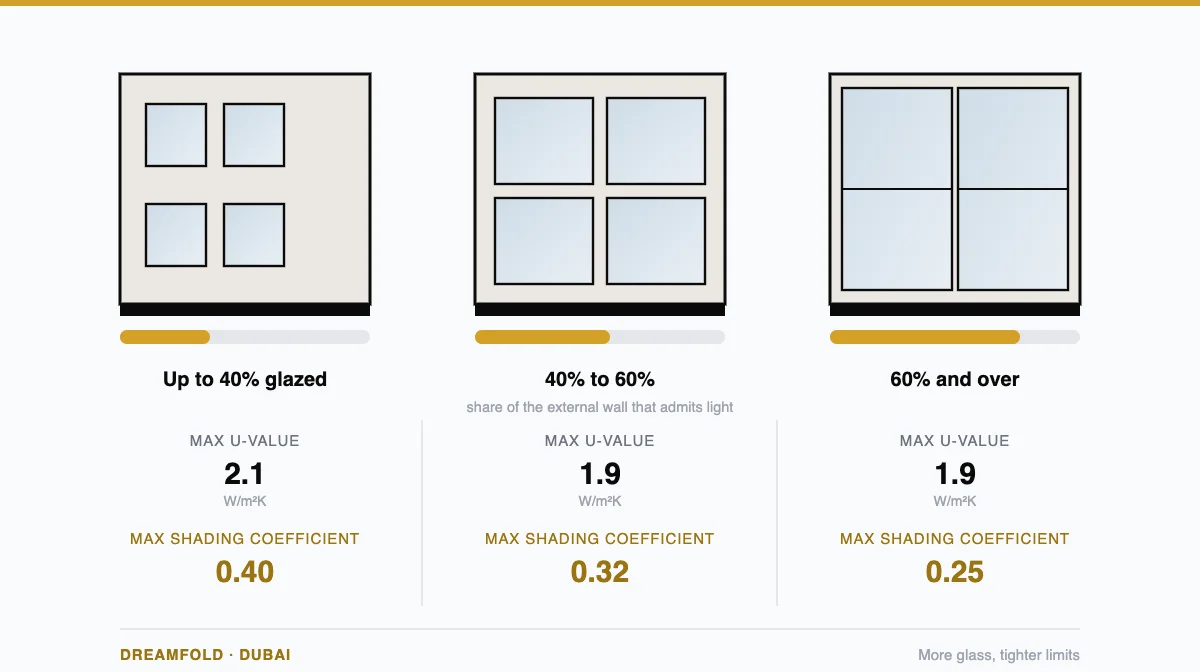
Al Sa'fat's elemental route sets glazing limits that step with how much of your external wall admits light. In the published regulations the thermal transmittance limit is 2.1 W/m²K where light-admitting walls are 40% or less of the external wall area, tightening to 1.9 W/m²K above that. Solar control is expressed as a shading coefficient rather than SHGC, with maxima stepping down from 0.40 to 0.32 to 0.25 across the same bands, alongside minimum light transmittance figures so that the solution is not simply "make it dark".
| Light-admitting external wall area | Max U-value | Max shading coefficient | What that means in practice |
|---|---|---|---|
| 40% or less | 2.1 W/m²K | 0.40 | Reachable with a good double-glazed unit and a hard-coat low-E |
| Over 40% up to 60% | 1.9 W/m²K | 0.32 | Soft-coat low-E in a sealed unit becomes the realistic route |
| 60% or more | 1.9 W/m²K | 0.25 | Solar-control soft coat, and the frame now matters as much as the glass |
| Shopfronts above ground floor | 1.9 W/m²K | 0.76 | Retail display is treated separately — see commercial entrances |
Read this before you quote those numbers at anyone. Al Sa'fat is revised periodically, and several UAE consultancy blogs currently publish figures for a newer edition that do not match the regulations as officially published — a flat 2.0 W/m²K and 0.25 SHGC with no banding, for instance. We have deliberately given you the banded figures from the published document. Treat them as the right shape of the requirement and confirm the edition in force for your permit with Dubai Municipality or your consultant before anyone orders glass.
A glazed door is a glazed element
Worth knowing: the definitions treat windows, skylights and doors that are more than half glass as glazed elements. A fully glazed bifold or sliding run is not exempt because it is called a door. It counts toward the glazed area and it has to meet the glazing performance, which is precisely why the thermal spec of a large door run can swing a whole elevation into the next band.
The frame is part of the answer
The regulations also require thermal bridges around doors and windows in air-conditioned buildings to be eliminated or insulated, with an alternative envelope route available for villas. No specific frame U-value is mandated, but the practical consequence is familiar to anyone who has touched an aluminium frame in August: a high-performance sealed unit in a non-thermally-broken frame leaks heat around the glass you just paid for. If you are specifying to a band, specify the frame at the same time. That is a conversation to have during door installation planning, not after.
Developments under other regulators publish their own design codes — Trakhees, for example, maintains its own regulations for the areas it administers.
Glass thickness: what actually drives the number
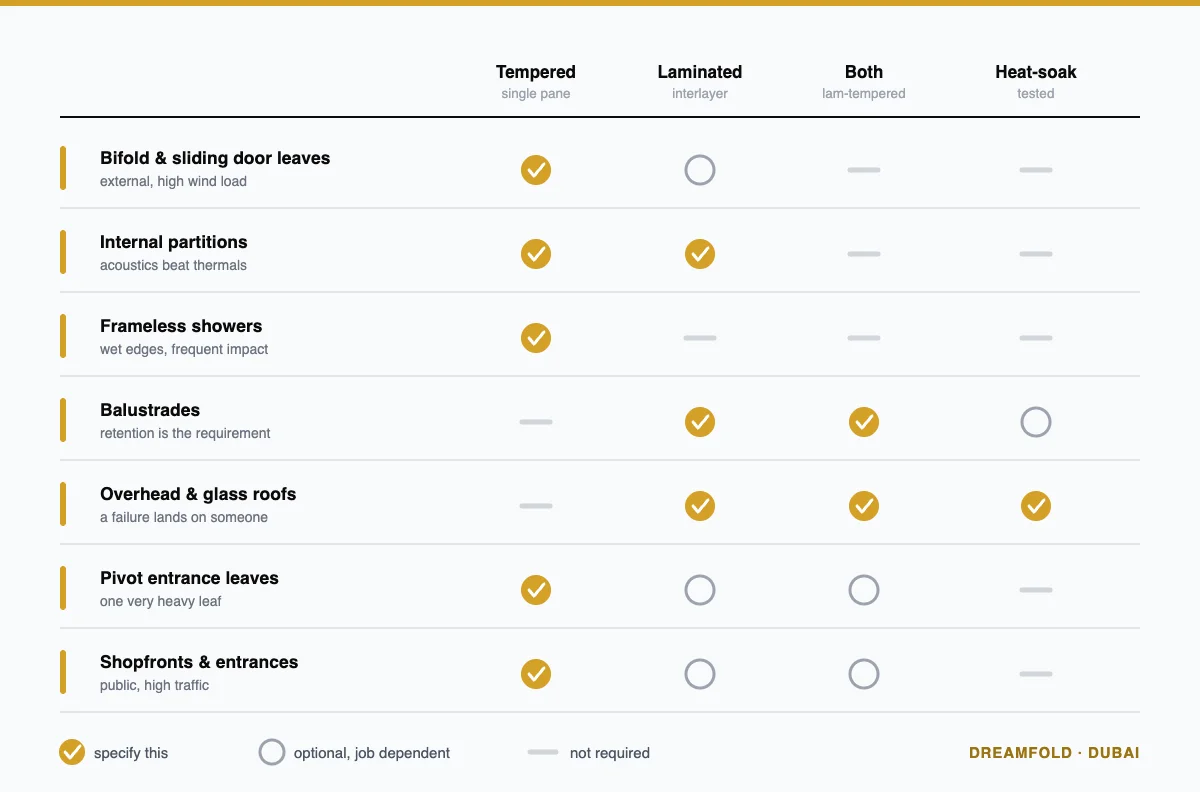
Thickness is an engineering output, not a preference. It is determined by the pane's dimensions, the wind load on that elevation and at that height, how many edges are supported, and what the hardware demands. The formal route is a load-resistance calculation to a standard such as ASTM E1300. The informal route — copying the last job — is how panels end up deflecting.
 Tap to enlarge
Some practical anchors from the work we do across Dubai:
- Internal screens and light-duty partitions: 8 mm or 10 mm toughened is the common range, with 10 mm once a panel is frameless and self-supporting.
- Frameless shower enclosures: 8 mm for a straightforward screen, 10 mm where the panel is tall, wide or carrying a hinged door. Our frameless shower enclosures page sets out the sizes properly.
- Bifold and sliding door leaves: 6 mm per leaf inside a double-glazed unit is typical; single-glazed internal leaves commonly run 8 mm or 10 mm.
- Large pivot leaves: thickness follows the leaf weight the hardware is rated for as much as the wind load. This is where the glass and the ironmongery have to be specified together.
- Overhead and balustrade: laminated, usually laminated-tempered, and heat-soak tested overhead. Thickness comes out of the structural calculation, not a rule of thumb.
The height trap. Wind load increases with height, so the same panel size that is fine on a villa ground floor is not automatically fine on the twenty-eighth floor of a tower. If you are replacing glass in an apartment, the original specification is your best guide — and the building's own rules may dictate it regardless.
How to read the glass line on a Dubai quote
A complete glass specification reads like a recipe, from outside to inside. Once you can parse it, comparing two suppliers takes thirty seconds instead of three meetings.
6 mm Tp low-E (#2) / 16 Ar / 6 mm Tp
Outer pane 6 mm tempered carrying a low-E coating on surface 2, a 16 mm argon-filled cavity, inner pane 6 mm tempered. This is a sound Dubai specification for a glazed door run.
10 mm Tp
Single pane, 10 mm tempered, no coating, no cavity. Correct for an internal partition or a shower. Not a thermal product — do not accept it on an external elevation and call the job done.
6 mm Tp / 1.52 PVB / 6 mm Tp
Laminated-tempered, 6 mm each side of a 1.52 mm PVB interlayer. Strength plus retention. Overhead glazing, balustrades, anything above people.
"Toughened glass"
Not a specification. It is a category. Ask for thickness, build-up, coating and coating surface before you compare it with anything.
Three questions that separate a real quote from a hopeful one:
- "Which surface is the coating on?" If the answer is not a number, the coating may not have been ordered at all.
- "Is that the centre-of-glass U-value or the whole-window figure?" They are different, and the gap is the frame and the spacer.
- "Is the glass heat-soak tested?" Only matters overhead — but if they do not know what you mean, that tells you something.
For the wider picture on what belongs in a door quote beyond the glass, see our breakdown of how to read a sliding door quote in Dubai.
The glass mistakes we see most often in Dubai
Buying strength instead of performance
Upgrading from 8 mm to 10 mm toughened single glazing and expecting a cooler room. Thickness does almost nothing for heat. The cavity and the coating do.
Specifying a sealed unit a slim frame cannot hold
Then discovering the sightline has grown, or the system has quietly been swapped. Decide performance and sightline together, before fabrication.
Low-E on the wrong surface
A heating-climate build-up installed in a cooling climate. Everything looks correct on paper and the elevation still bakes.
Tempered where laminated was required
Usually overhead, usually to save money, occasionally after a value-engineering exercise nobody told the client about.
No heat-soak testing above head height
Fine for years, and then one pane empties itself over a terrace for no visible reason.
Re-measuring after ordering
Tempered glass cannot be trimmed. A 5 mm error is a new pane, not an adjustment.
Have a quote in front of you?
Send us the glass line exactly as it is written. We will tell you what it means, what is missing from it, and whether it suits the elevation it is going on.
What this means for each kind of door
The same four decisions land differently depending on what the glass is sitting in.
Bifold and folding doors
Many leaves, lots of glass, usually an external elevation. Double-glazed with a surface-2 low-E is the default worth paying for, with 6 mm tempered each side. Internal runs can drop to single toughened.
Aluminium bifold doors · internal folding doors · 3-panel layouts
Sliding and telescopic doors
Fewer, heavier panels. Glass weight drives the roller and track specification, so thickness and build-up have to be fixed before the hardware is ordered.
Ultra-slim and frameless systems
The sightline is the product. Confirm early what glazing depth the profile accepts, because that caps your thermal options before anything else is decided.
Pivot entrance doors
One very heavy leaf. Glass build-up is a structural input to the pivot hardware, and the leaf is usually the most exposed glass on the building.
Partitions and office glazing
Internal, so thermal performance is irrelevant and acoustics are everything. This is laminated glass territory, with unequal panes either side of an acoustic interlayer.
Wet areas and bathrooms
Tempered, 8 mm or 10 mm, with the edge detail doing more work than the glass grade. Where laminated is used at an exposed edge, EVA tolerates moisture better than PVB.
Fire-rated openings
A separate product class entirely. Fire-rated glazing is tested as a complete assembly — glass, frame, gaskets and hardware together — and nothing in this guide substitutes for that certification.
Shaded outdoor structures
Overhead glass means laminated, heat-soak tested, and a drainage detail that survives a Dubai downpour. Louvres avoid the question altogether.
If you are maintaining rather than buying, glass grade also changes how you clean and inspect: our notes on bifold door maintenance and on the real disadvantages of sliding glass doors both come back to glass weight and edge condition.
Tempered vs laminated glass: frequently asked questions
Is tempered glass the same as toughened glass?
Yes. They are two names for the same product — glass that has been heat treated to put its surfaces into compression. "Tempered" follows American terminology and "toughened" follows British, and both appear on Dubai quotes depending on where the supplier learned the trade. If a quote uses both words for different line items, ask, because it may just be two different suppliers' paperwork stitched together.
Which is stronger, tempered or laminated glass?
Tempered, by a clear margin, if strength means resistance to breaking. Fully tempered glass is around four times stronger than annealed glass of the same thickness. But laminated glass is not trying to win that contest — its job is to stay in the opening after it breaks. For overhead glazing and balustrades, retention matters more than strength, which is why laminated is specified there even though it breaks more easily.
Do I need double glazing in Dubai, or is single toughened glass enough?
For an external elevation with any meaningful area of glass, double glazing with a low-E coating is the only route to the performance Dubai's green building requirements expect, and the only one that makes a noticeable difference to how a room feels in summer. Single toughened glass is correct for internal partitions, showers and small shaded openings. It is not a thermal product, however thick it is.
What does low-E glass actually do?
Uncoated glass has an emissivity around 0.91, so it re-radiates heat readily. A low-emissivity coating is a microscopically thin metallic layer that cuts that figure sharply, reflecting infrared rather than passing it on. In Dubai the coating belongs on surface 2 — the inner face of the outer pane — so that it intercepts solar heat before the cavity absorbs it. The best-performing coatings are sputtered, contain silver, and must be sealed inside a double-glazed unit because they oxidise in open air.
Why did my tempered glass break on its own with nothing touching it?
Almost certainly a nickel sulfide inclusion. A microscopic particle inside the tensile core of the pane slowly changes volume until it cracks the glass from the inside, and it can happen years after installation. The tell-tale is a figure-eight break pattern with two loops about 30 mm across at the origin. It is rare, it is not an installation fault, and the way to protect against it where a failure would be dangerous is to specify heat-soak-tested glass.
What is heat-soak testing and when should I pay for it?
After tempering, panes are held at elevated temperature so that any unstable nickel sulfide inclusions fail in the factory rather than in your building. It is not free and it is not needed everywhere. Specify it for skylights, glass roofs, overhead glazing and anything above a seating area or walkway. Skip it on ordinary ground-floor doors and internal screens.
How thick should the glass in my sliding or bifold door be?
Inside a double-glazed unit, 6 mm per leaf is typical. Single-glazed internal leaves commonly run 8 mm or 10 mm. But thickness is properly an output of a calculation — pane size, wind load at that height and orientation, how many edges are supported, and what the hardware is rated to carry. Wind load rises with height, so an apartment on a high floor is not the same case as a villa ground floor even with identical panel sizes.
Can tempered glass be cut or drilled after it is made?
No. Any cutting, drilling, notching or edge grinding has to happen before the pane goes through the furnace. Attempting it afterwards shatters the whole panel. This is why final site dimensions have to be confirmed before glass is ordered, and why a measurement error becomes a replacement pane rather than an adjustment.
Does laminated glass really reduce noise?
Yes, and noticeably more than a single pane of the same total thickness, because the interlayer damps vibration rather than transmitting it. Two further points matter in practice: with PVB you need a specific acoustic grade, as standard PVB is not an acoustic product, and combining unequal glass thicknesses either side of the interlayer works better than matching them. For a road-facing apartment this is usually the most effective glass change available.
How long does a double-glazed unit last before it mists up?
Service life is typically quoted at 10 to 25 years, with warranties commonly 10 to 20 years. When the perimeter seal eventually fails, moisture enters the cavity and the misting is permanent, because the affected surfaces are inside the sealed unit and cannot be cleaned. Dubai's heat cycling and UV exposure push units toward the harsher end of that range, so sealant quality and a frame that shades the unit edge are worth paying attention to.
Do I need approval to change the glass in my villa or apartment?
It depends on what you are changing and where. Swapping like-for-like glass inside an existing frame is usually treated differently from altering an opening or changing the external appearance, and the answer varies by authority and by community. We set out who signs off what in our guide to door and glass approvals in Dubai.
Send us the opening. We will tell you the glass.
Free site survey across Dubai and the UAE. We measure, work out the load case, specify the build-up and coating properly, and put the whole specification in writing — thickness, cavity, gas fill and coating surface — so you can compare it against anyone else's quote line for line.