I was genuinely panicking the first summer I moved into our villa in Jumeirah. The electricity bill arrived in August and I just stood there in the kitchen staring at it AED 4,200 for a single month. For a three-bedroom house. I almost called the utility company to report a mistake.
The AC was running non-stop, the compressor outside sounded like a helicopter trying to take off, and the living room was still hitting 27°C even with everything set to 20°C. I had floor-to-ceiling glass doors beautiful, yes but absolutely useless at keeping the heat out.
I tried the standard advice. Blackout curtains. A reflective film on the glass. Switching the AC to ‘eco mode.’ None of it made a real dent. Wait, it gets worse the curtains made the space feel like a cave, which completely defeated the reason I bought a home with a glass wall in the first place.
That’s when a contractor friend of mine dropped a single phrase: thermal break bifold doors Dubai. I had no idea what that meant. Two months and a lot of research later, my August bill was AED 2,650. Same house. Same summer. That difference is what this article is about.
What Exactly Are Thermal Break Bifold Doors And Why Does Dubai Need Them?
| Short answer: A thermal break bifold door uses a non-conductive barrier inside the aluminium frame to stop heat from transferring between the outside and inside. In Dubai’s climate where outdoor temperatures routinely exceed 45°C this barrier is the difference between a door that fights your AC and one that supports it. |
Standard aluminium is a fantastic conductor of heat. That’s great for frying pans, not so great for door frames in a city where the sun turns your patio tiles into a griddle. When you have a conventional aluminium bifold door, the frame itself becomes a heat highway outdoor temperatures travel straight into your cool interior, and your AC unit works twice as hard to compensate.
A thermal break changes this. Manufacturers insert a polyamide strip (essentially a hard plastic barrier) between the inner and outer parts of the aluminium profile. That tiny strip sometimes just 14mm to 34mm wide does the heavy lifting. It breaks the thermal bridge. Heat no longer has a direct route through your frame.
Pair that with double-glazed or triple-glazed glass panels and you have a door system that genuinely insulates your home instead of undermining it.
The Real Energy Savings Numbers: What You Can Actually Expect in Dubai
| Short answer: Homeowners in Dubai who upgrade to thermal break bifold doors report AC energy savings of 25% to 40%, with bills often dropping by AED 800 to AED 1,800 per month in peak summer. The payback period on a quality installation typically runs 3 to 5 years. |
Let me be honest: the exact savings depend on your home’s size, orientation, insulation quality, and how aggressively you run the AC. But the data from across the UAE is pretty consistent.
According to the UAE Ministry of Energy and Infrastructure, buildings in the UAE account for roughly 70% of total electricity consumption and cooling systems alone represent the largest share of that load. Reducing heat gain through windows and doors directly targets that number.
Studies on thermal insulation in hot-arid climates have found that improving glazing and frame performance can reduce cooling loads by 30% to 45% in buildings with significant glazed facades. For a typical Dubai villa with large bifold openings facing south or west, that’s not a marginal improvement it’s a meaningful monthly saving.
And honestly? The energy bill is only part of it. Your AC unit lasts longer when it’s not constantly running at full capacity. The compressor takes years of wear off its lifespan. People don’t always count that when they calculate ROI, but they should.
The Opinion Most People Don’t Want to Hear
Most villa owners in Dubai make the mistake of spending a fortune on interior design and then fitting the cheapest possible door system. I get it the doors are an afterthought by the time the budgets are stretched. But a standard aluminium bifold door in a west-facing Dubai living room is essentially a very expensive hole in your insulation. You’re not just losing money on energy bills; you’re offsetting every other thermal upgrade in your home.
Comparison: Thermal Break vs Standard vs uPVC Bifold Doors in Dubai
| Short answer: Thermal break aluminium bifold doors consistently outperform both standard aluminium and uPVC options in Dubai’s extreme heat. They offer the best combination of energy performance, durability, and aesthetics for the local climate. |
| Option | Best For | Pros | Cons |
| Thermal Break Bifold Doors | Villas, luxury apartments, full open-plan living | Max energy savings (up to 40%), sleek looks, noise reduction | Higher upfront cost vs standard aluminium |
| Standard Aluminium Bifold Doors | Budget projects, covered patios, low direct sun exposure | Affordable, widely available | Conducts heat your AC works overtime |
| uPVC Bifold Doors | Moderate climates, cost-sensitive builds | Decent insulation, lower price | Less durable in extreme Dubai heat, less elegant aesthetics |
One thing I’ll say from experience: uPVC doors sound appealing on paper until you’ve seen what a Dubai summer does to cheaper plastic profiles after three to four years. They warp, the seals go, and suddenly your ‘budget-friendly’ choice starts leaking hot air like a broken thermos.
How to Choose the Right Thermal Break Bifold Door for Your Dubai Home
| Short answer: Look for a thermal break depth of at least 24mm, low-E double glazing with an argon gas fill, and a reputable local supplier who can properly seal and install the system. Poor installation kills even the best door’s thermal performance. |
Here’s what I learned the hard way about what actually matters when you’re shopping for thermal break bifold doors in Dubai:
- Check the thermal break depth. A 14mm break is the minimum 24mm to 34mm is significantly better. Deeper breaks mean more insulation. Ask any supplier for the U-value of their system. A good thermal break door should have a frame U-value below 2.0 W/m²K.
- Specify low-E glass with argon fill. Standard double glazing reduces heat gain, but low-emissivity (low-E) coated glass which has a near-invisible metallic layer cuts solar heat gain by an additional 20 to 30%. The argon gas between the panes adds another layer of thermal resistance. This combination is non-negotiable in Dubai.
- Look at the Solar Heat Gain Coefficient (SHGC). For Dubai’s climate, target an SHGC below 0.25 for any west- or south-facing facade. This number tells you how much solar radiation passes through the glass into your home.
- Don’t ignore the seals and hardware. A thermal break frame loses half its advantage if the weather sealing isn’t tight. Brush seals, compression gaskets, and proper perimeter sealing are what actually keep the hot air out in daily use.
- Use a specialist local installer. A bifold door system needs to be set dead-level and plumb, with sill drainage sorted before installation. An improperly fitted thermal break door will underperform. In Dubai specifically, you need installers who understand how thermal expansion of aluminium behaves through the daily 20°C+ temperature swings from night to noon.
Step-by-Step Guide: How to Upgrade to Thermal Break Bifold Doors in Dubai
| Short answer: The upgrade process takes 4 to 6 weeks from consultation to completion and typically involves a site survey, custom fabrication, removal of existing doors, installation, and sealing. Choosing the right partner from the start prevents costly mistakes. |
Step 1: Assess Your Current Setup
Measure your existing opening accurately width, height, and depth of the reveal. Note which direction the opening faces (north, south, east, west) because this affects your glass specification. South and west-facing openings in Dubai need the highest-performance glass.
Step 2: Request Thermal Performance Data
Any serious supplier should be able to provide you with the U-value, SHGC rating, and Visual Light Transmittance (VLT) figures for the specific system you’re considering. If they can’t, walk away. You want numbers, not promises.
Step 3: Choose Your Configuration
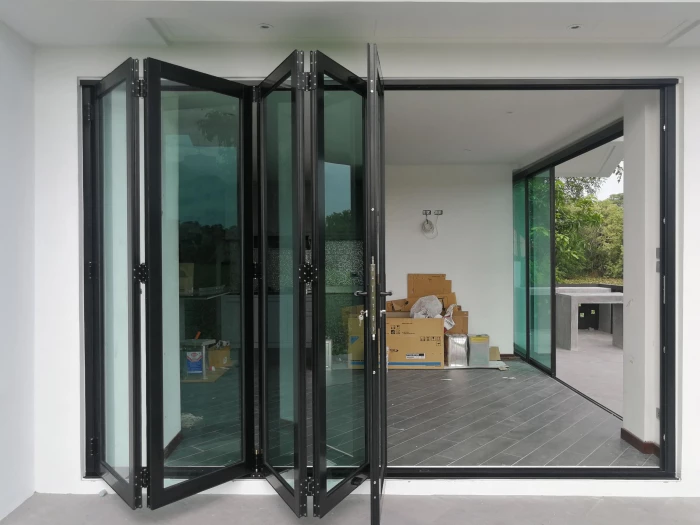
Decide on the number of panels (typically 3 to 6 for residential use), the opening direction (traffic door left or right), and the stacking configuration. For Dubai homes, a full-width opening is popular but make sure the door pockets into a shaded area where possible.
Step 4: Arrange Custom Fabrication
Thermal break bifold doors are made to measure. Lead time in Dubai is typically 3 to 5 weeks from order confirmation. Use this time to sort the floor finish and sill detail so the installation goes smoothly.
Step 5: Professional Installation and Sealing
Installation usually takes one to two days depending on the size of the opening. Ensure the installer checks the thermal seal at every panel junction, applies proper external sealant, and tests the drainage. A final air-tightness check simply running your hand around the perimeter with doors closed on a hot day will confirm the seal is working.
Key Takeaways
- Thermal break bifold doors in Dubai can reduce AC energy consumption by 25% to 40%, delivering real monthly savings on electricity bills.
- The thermal break barrier typically made of polyamide interrupts the heat conduction pathway through the aluminium frame, which is the primary cause of heat gain through standard doors.
- Always specify low-E double glazing with argon fill and an SHGC below 0.25 for south- or west-facing Dubai openings.
- Poor installation destroys even the best door’s thermal performance. Use a specialist local installer with verifiable UAE project experience.
- uPVC bifold doors degrade faster in Dubai’s extreme climate. Thermal break aluminium is the more durable and cost-effective long-term choice.
- The payback period on a quality thermal break bifold door installation is typically 3 to 5 years through energy savings alone not counting AC longevity benefits.
Frequently Asked Questions
1. How much can I save on my electricity bill with thermal break bifold doors in Dubai?
Most homeowners in Dubai report monthly savings of AED 800 to AED 1,800 in summer depending on the home size and current door setup. Annual savings across a full year typically range from AED 6,000 to AED 15,000.
2. Are thermal break bifold doors worth the extra cost in Dubai?
Yes the upfront premium over standard aluminium is typically recovered within 3 to 5 years through reduced energy bills. In Dubai’s extreme summer climate, the ongoing savings are significant and consistent.
3. What glass specification should I use for a west-facing bifold door in Dubai?
Use low-E double glazing with an argon gas fill and a Solar Heat Gain Coefficient (SHGC) of 0.25 or lower. Triple glazing is also an option for maximum performance but is rarely required in Dubai’s climate.
4. How long does installation of thermal break bifold doors take in Dubai?
From order to installation, the process typically takes 4 to 6 weeks including fabrication lead time. Physical installation at your home usually takes one to two days.
5. Will thermal break bifold doors reduce noise as well as heat?
Yes. The double glazing and improved frame sealing that deliver thermal performance also significantly reduce external noise. For Dubai homes near busy roads or communal areas, this is a notable added benefit.
6. What is the U-value I should look for in a Dubai thermal break bifold door?
Target a whole-door U-value of 1.8 W/m²K or lower. The frame U-value alone should be below 2.0 W/m²K. These figures indicate genuinely effective thermal insulation for hot climates.
7. Can I retrofit thermal break bifold doors without major structural work?
In most cases, yes. If your existing opening has a standard structural reveal, thermal break bifold doors can be fitted as a direct replacement. A site survey by a specialist will confirm whether any structural modification is needed.
Conclusion
If I could go back and do one thing differently in my Dubai home, it would be to fit thermal break bifold doors from day one. Not because they look better (they do), not because they open the living space beautifully (they do that too), but because every single summer since the upgrade I have not once panicked at my electricity bill.
The math is simple. Dubai summers are brutal. Glass doors are unavoidable if you want the lifestyle. The only logical response is to insist on a door system that works with your AC instead of against it. Thermal break bifold doors in Dubai are that system.
Ready to stop overpaying on your AC bills? Visit Dreamfold.ae to explore our full range of thermal break bifold doors in Dubai, or get in touch with our team for a free site survey and energy savings consultation. Your next electricity bill will thank you