I was standing in a half-finished villa in Dubai Hills the kind of project where everything looks perfect on the architect’s render and the interior designer turned to me and said, “We still haven’t figured out the wall.”
The wall. A 6-metre-wide stretch of concrete separating the living room from a pool terrace that cost more than most people’s cars. Sliding doors felt clunky. French doors would eat into the opening. And a fixed glass panel? Don’t even say that out loud in front of a Dubai homeowner in August.
That was the moment I started taking bi-fold doors seriously not as a trendy architectural detail, but as a genuine engineering solution for large openings in premium spaces.
If you’ve been staring at that same impossible wall in your villa, apartment, or commercial space, this is the article I wish I’d found two years ago.
What exactly are bi-fold doors and why do villas love them?
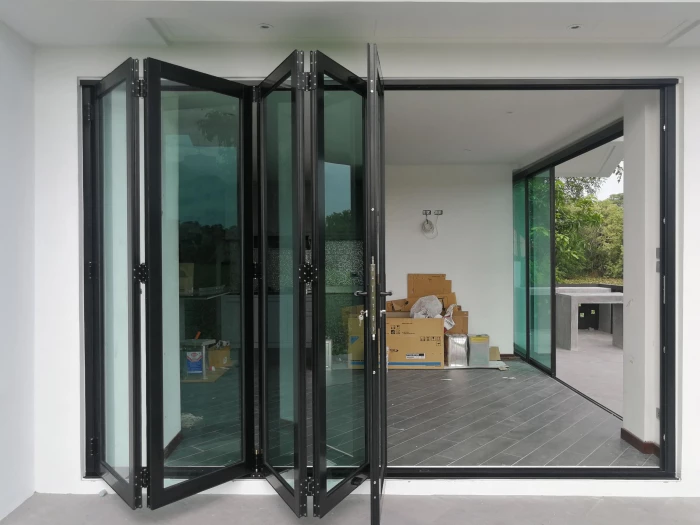
The mechanics are beautifully simple: multiple door panels hang from an overhead track and fold accordion-style. You can stack them left, right, or split them to both sides. A 5-metre opening can become 95% open air in about 10 seconds.
For Dubai villas specifically, this matters for three reasons. First, the indoor-outdoor lifestyle isn’t optional it’s the entire point of having a pool terrace. Second, the sheer scale of modern villa openings rules out most traditional door types. Third, UAE homeowners have increasingly refined tastes, and bi-fold doors simply look the part.
The real problem most people don’t talk about
Most people choose bi-fold doors based on how they look in a showroom on a 22°C spring day. Nobody tests them at 45°C with direct western sun hammering the frame. In Dubai, thermal performance isn’t a feature — it’s the entire purchase decision.
Here’s what I learned the hard way: aluminium frames with thermal break technology are non-negotiable in the Gulf climate. A standard aluminium bi-fold without a thermal break will turn your living room into a slow oven and blow your DEWA bill through the roof of that beautiful villa.
And honestly? The structural load question is just as important. A 6-panel bi-fold system is heavy. The header beam above the opening, the floor track (or lack of it in frameless systems), and the quality of the hardware all determine whether your doors glide like a Rolls-Royce or drag like a trolley with a wonky wheel.
Bi-fold vs. sliding vs. pivot doors: which wins for large openings?
| Door Type | Best For | Pros | Cons |
|---|---|---|---|
| Bi-fold doors | Villas, wide terraces, 3m–10m spans | Maximum open span; flexible stacking; premium aesthetics; good thermal options | Higher cost; requires maintenance on hinges and tracks; more complex installation |
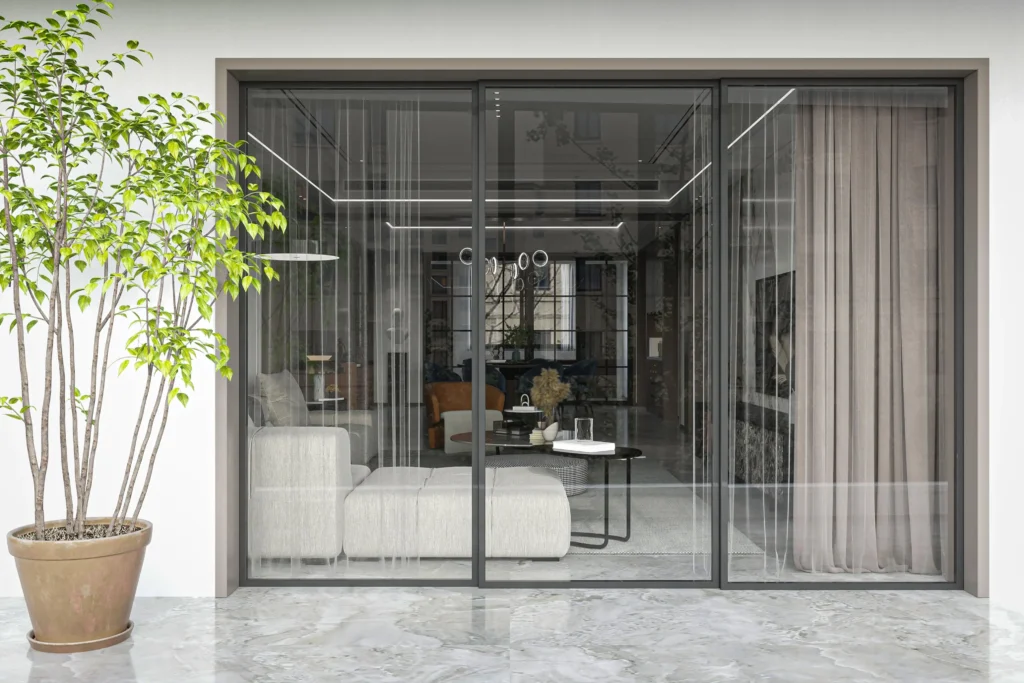
| Sliding doors | Moderate spans, apartments, compact spaces | Simple operation; lower cost; easy to clean | Only 50–60% of opening clears; panels overlap behind frame; less dramatic visual impact |
| Pivot doors | Entryways, single statement openings | Architectural drama; minimal hardware visible; works frameless | Single panel only; impractical for wide spans; expensive pivot hardware |
Wait, it gets more nuanced. If your opening is between 3m and 4.5m and you don’t need full clear span, a high-quality sliding system from a reputable manufacturer might actually serve you better operationally bi-folds with 6+ panels require more user effort to open and close every time. But if you want that moment guests walking in and seeing your pool terrace as a seamless extension of the living room bi-fold wins. Every time.
How to choose the right bi-fold door system for your villa: a step-by-step guide
- Measure the structural opening accuratelyDon’t rely on architect drawings alone. Have a specialist measure the actual header clearance, floor levelness, and side wall depth before specifying any system. Even a 5mm floor slope across 6 metres will affect how bi-fold panels hang and seal.
- Decide on thermally broken aluminium vs. uPVC vs. timberFor Dubai and the wider UAE, thermally broken aluminium is the correct answer for large openings 95% of the time. uPVC is fine for smaller panels but struggles structurally at wide spans. Timber is beautiful but requires serious maintenance in humidity-variable environments like coastal properties.
- Choose your panel configuration and stacking directionDecide whether panels stack to one side (simpler track, cleaner look) or split to both sides (more symmetrical, better for centred openings). Also confirm the number of panels more panels means narrower leaves but more fold points. Most villa applications use 4–6 panels.
- Specify the glazing unitFor Dubai’s climate, double-glazed units with low-E coating are the baseline. For extreme west-facing elevations, triple glazing or solar-control laminated glass should be on the table. The glass is often where the real energy performance difference sits not the frame.
- Get the hardware right from the startStainless steel rollers, multi-point locking systems, and quality threshold seals are not places to cut budget. Inferior hardware is what makes bi-fold doors feel cheap and in a Dubai villa, that is not a feeling you can afford.
- Plan the floor threshold carefullyLow-profile or flush thresholds look stunning but require very precise floor prep. If your tiling and screed aren’t perfectly level, a flush threshold will seal poorly. Discuss this with your installer before the floor goes down not after.
Design ideas: how Dubai’s top villa projects are using bi-fold doors
The full-wall disappearing act
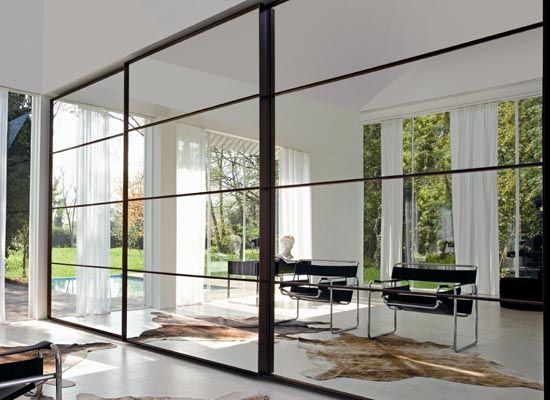
The most dramatic application is a complete wall replacement: bi-fold panels spanning the entire side of a living room, opening to a pool terrace. When fully open, there’s no visible frame, no wall, no separation. The interior rugs, sofas, and pendant lights coexist with the outdoor loungers and water feature. This requires careful planning of the floor finish level, ceiling height, and overhead track concealment but the result is unforgettable.
The corner bi-fold configuration
Increasingly popular in contemporary villas is a corner bi-fold setup: two sets of panels meeting at a structural corner, both opening outward so the entire corner of the building disappears. The corner post often the main visual obstacle in this design can be engineered away entirely in certain frameless systems. This is a genuinely architectural move, and it requires a structural engineer involved from day one.
Bedroom-to-balcony integration
Master bedrooms in Dubai villas increasingly treat the balcony as an extension of the bedroom rather than a separate space. A 3-panel bi-fold on the bedroom wall creates a morning ritual open the panels, step straight onto a private terrace, coffee in hand, Dubai skyline in front. It’s a small configuration but the lifestyle impact is disproportionately large.
Frameless bi-fold systems look incredible in renders. In real life, in a UAE climate with dust storms and cleaning requirements, a well-made slim-frame aluminium system is often more practical and ages far better. Choose the system you’ll still love maintaining in year five, not just year one.
Key takeaways
- Bi-fold doors are the best solution for villa openings wider than 3 metres because they deliver maximum clear span and seamless indoor-outdoor connection
- Thermally broken aluminium frames are essential in the UAE climate never compromise on this specification
- Panel count, stacking direction, and threshold type must be decided before floor finishes go down not after
- Hardware quality determines long-term performance cheap rollers and seals are the number one cause of bi-fold door problems
- Glazing specification (low-E, solar control, double vs. triple) has more impact on energy performance than the frame material
- Corner bi-fold configurations and full-wall disappearing systems require structural engineering input from early in the project
Frequently asked questions
Yes provided the system uses thermally broken aluminium frames and double or triple-glazed units with low-E or solar-control coatings. Without thermal break technology, bi-fold doors will significantly increase your cooling load.
High-quality bi-fold systems can span up to 10 metres or more with the right structural support above the opening. The overhead beam specification is critical consult a structural engineer for any span above 5 metres.
Top-hung systems hang from an overhead track with minimal floor contact, giving a cleaner threshold line and better dust performance. Bottom-rolling systems carry panel weight on floor rollers and are typically used for very heavy panels. For most villa applications in Dubai, top-hung is the preferred specification.
Clean the track channels monthly with a dry brush or vacuum to remove dust and debris, and lubricate the rollers with silicone-based lubricant every 6–12 months. Avoid oil-based lubricants as they attract dust. Wipe the rubber seals down with a damp cloth to maintain their elasticity.
Yes this is one of the most common applications in Dubai villa design. The system must be correctly weathersealed and the glazing specified for UV exposure and thermal performance, but bi-fold doors are fully engineered as exterior building elements.
Interior designers and real estate professionals consistently report that high-quality bi-fold door systems particularly those creating seamless indoor-outdoor living spaces are among the features that buyers mention most positively in upper-market Dubai villa transactions.
Bi-fold doors read best with ceiling heights of 2.7 metres or above at this height the panels have genuine vertical presence. Floor-to-ceiling bi-folds in rooms with 3-metre or higher ceilings create the most dramatic effect and are increasingly standard in Dubai villa specifications.
Conclusion
If you’d told me two years ago that I’d end up writing a thousand-word love letter to door hardware, I’d have laughed. But here’s what I learned standing in that half-finished villa in Dubai Hills: the right door system isn’t a finishing touch. It’s a structural decision that shapes how a space feels every single day.
Bi-fold doors for villas aren’t popular because they’re fashionable they’re popular because they solve a problem that no other door type solves as completely. Large openings. Seamless indoor-outdoor connection. Thermal performance in a brutal climate. And that feeling, when you fold back six panels on a November morning and your living room and pool terrace become one continuous space, that’s not a detail. That’s the whole point.
Get the specification right thermally broken frames, quality glazing, proper hardware, precise installation — and bi-fold doors will be the best decision you make in your villa project. Get it wrong, and they’ll be the one thing you regret most.
Ready to transform your villa opening?
Dreamfold specialises in premium bi-fold door systems designed for Dubai’s climate and lifestyle. From first consultation to installation, we handle every detail so you don’t have to.
Related reading: Two things worth reading before specifying a villa opening: the energy case for thermal-break bifold doors, and how folding windows bring more daylight into a villa.